How Much Does a Funeral Cost? Start With the Fees, Not the Average
Search that question and you will get a number. You will also get a different number on the next page, and a third number on the page after that. One site says the average American funeral costs $7,848. Another says $8,300. Another says somewhere between $8,300 and $13,000. They cannot all be right, and the spread between the lowest and the highest is more than five thousand dollars, which is real money to a family that just lost someone and has four days to make decisions.
Here is what almost nobody tells you. Every one of those numbers traces back to a single survey of funeral home price lists, and the newest one was published in 2023. The averages are not measurements of what you will pay. They are the middle of a very wide range, quoted without a date, and the range is where your money actually lives. Two funeral homes that Google itself ranks first and second for funeral home pricing charge $1,495 and $2,395 for the exact same non-declinable fee, and neither one of them is doing anything wrong. That is a 60 percent difference before a single choice has been made.
So this guide does not lead with an average. Federal law requires every funeral home in the United States to hand you an itemized General Price List before you agree to anything, and that document, not a national median, is what decides your bill. This walks that list line by line: what each item is, which single fee you cannot decline, which ones you can, what the numbers actually look like at real funeral homes publishing real prices right now, and where the money goes when families are not watching. No pressure, no scare tactics, and no invented figures. Every number below is sourced and dated.

A funeral costs a median of $8,300 with a viewing and burial and $6,280 with a viewing and cremation in the United States, per the National Funeral Directors Association’s 2023 price study, the newest one published. Neither figure includes cemetery costs, and federal law gives you an itemized price list that can bring either one down.
- What a direct cremation costs at a funeral home: A direct cremation, the least expensive funeral arrangement, runs from $800 to $4,160 across 231 Georgia funeral homes for the identical service, with a median of $2,145. It has no viewing and no ceremony beforehand, and it uses a simple alternative container instead of a casket.
- What an immediate burial costs at a funeral home: An immediate burial, which is a burial with no viewing and no ceremony, runs from $1,745 to $7,500 across 231 Georgia funeral homes, with a median of $3,710. Cemetery costs are billed separately and are not on the funeral home’s price list.
- Whether a funeral home has to give you a price list: A funeral home must hand you an itemized General Price List at the start of any in-person talk about arrangements, under the FTC Funeral Rule, before you see a casket or pay a deposit. Only one fee on that list cannot be declined, the basic services fee, and it is $1,495 at Golden Gate Funeral Home in Dallas and $2,395 at Price Funeral Chapel in Sacramento.
- What buying your own casket saves on a funeral: The FTC Funeral Rule lets you buy a casket from any seller, and the funeral home must accept it and cannot charge a handling fee. On one Sacramento price list read by Memorial Merits in August 2026, the same immediate burial costs $1,550 more with the funeral home’s casket than with one you supply.
- Whether embalming is required for a funeral: No federal law requires embalming, and the FTC Funeral Rule bars a funeral home from claiming that one does. One funeral home price list read by Memorial Merits in August 2026 charges $1,200 for embalming and $400 for washing, disinfecting and dressing without it.
- Whether a funeral home has to give prices over the phone: A funeral home must tell you its prices over the phone when you call and ask, under the FTC Funeral Rule, and you do not have to give your name or come in. Calling three funeral homes before you authorize anything is how a family finds the spread between them.

Every Fee on the General Price List, and What Each One Costs
The General Price List, usually shortened to GPL, is the document at the center of funeral home pricing. Under the FTC Funeral Rule, a funeral home must give you a printed, itemized price list at the start of any in person discussion about arrangements, before showing you a casket, before taking a deposit, and whether or not you ask for it. You are allowed to take it home. You are allowed to take it to three other funeral homes and compare. Most families never do, because nobody tells them the document is a shopping tool rather than a formality.

The list is organized into categories that are the same everywhere, because federal law standardizes them. What changes from one funeral home to the next is the number beside each line, and those numbers are not close to each other.
| Line item | Can you decline it | What it costs, from published price lists |
|---|---|---|
| Basic services of funeral director and staff | No. This is the only fee a funeral home may require. | $1,495 in Dallas, $2,395 in Sacramento |
| Transfer of remains into their care | Practically unavoidable | Neither list read here published it. Ask for the figure and the mileage radius. |
| Embalming | Yes. No state requires it routinely. | $1,200 in Sacramento |
| Limited physical care instead of embalming | Yes | $400 in Sacramento |
| Special care after autopsy or organ and tissue donation | Situational | $300 in Sacramento |
| Surgical removal of a pacemaker | Required before cremation for safety | $200 in Sacramento |
| Use of facilities for viewing or visitation | Yes | Varies with facility size. Removed entirely if held elsewhere. |
| Use of facilities and staff for a ceremony | Yes | Removed if the service is at a church or graveside. Ask whether a staff attendance fee replaces it. |
| Hearse | Yes | Bundled into most packages and separable on request |
| Additional vehicles | Yes | $125 per limousine in Dallas, specialty vehicles to $2,000 |
| Casket | Yes, and you may supply your own with no handling fee | $595 to $60,000 in the Dallas showroom. Partner floors from $995 delivered free. |
| Alternative container for cremation | Yes. Cardboard or unfinished wood is legal everywhere. | A fraction of a casket |
| Outer burial container or vault | No state requires one. Individual cemeteries may. | $500 to $40,000 in the Dallas showroom |
| Urn | Yes. Buy anywhere, or wait. | The temporary container is included and is adequate for months |
| Direct cremation, the floor option | This is the floor, not an add-on | $800 to $4,160 across 231 Georgia funeral homes. Median $2,145. |
| Immediate burial, the other floor | This is the floor, not an add-on | $1,745 to $7,500 across the same 231. Median $3,710. |
| Immediate burial, casket supplied by you vs by them | Your choice | $2,395 with your casket, $3,945 with theirs, in Sacramento |
| Forwarding remains to another funeral home | Situational | $2,895 in Sacramento |
| Receiving remains from another funeral home | Situational | $2,395 in Sacramento |
| Cemetery costs | Separate business, separate bill | Plot, opening and closing, marker and its setting fee. Not on the funeral home list at all. |
| Crematory fee | Sometimes excluded from the price list | Add roughly $300 when comparing lists |
Sources, all read in August 2026: the published General Price Lists of Golden Gate Funeral Home, Dallas and Price Funeral Chapel, Sacramento, the 231 establishment price survey published by the Funeral Consumers Alliance of Georgia, and the 2023 NFDA General Price List Study. Prices are what those funeral homes publish for their own market and are shown to illustrate the spread, not to predict your local total.
Two things are worth understanding before you read a single price. First, a package quote is a bundle of these lines with a discount attached, and it is not always cheaper than choosing the same items individually. You are entitled to buy à la carte and the funeral home has to let you. Second, the categories that feel emotional, the casket and the flowers and the register book, are the ones where the markup lives, and the categories that feel administrative are the ones you cannot avoid. Knowing which is which is most of the battle.
The One Fee You Cannot Decline
Every General Price List has a line called the basic services of funeral director and staff. It covers the things the funeral home does whether you hold a service or not: securing permits and death certificates, coordinating with the cemetery or crematory, staff availability, and the overhead of keeping a licensed facility open. Under the Funeral Rule, this is the only fee a funeral home may require you to pay no matter which arrangement you choose. Everything else on the list is optional.
Because it is non-declinable, it is also the fee that decides more of your final bill than any other single line, and it is the one families almost never compare. Here is what it costs at the two funeral homes Google currently ranks first and second for funeral home pricing, taken directly from their own published price lists in August 2026.
- Golden Gate Funeral Home, Dallas, Texas: basic services of funeral director and staff, $1,495.
- Price Funeral Chapel, Sacramento, California: basic services of funeral director and staff, $2,395.
Nine hundred dollars separates them, on a line neither family gets to refuse, before anyone has chosen a casket or booked a chapel. Both figures are published openly. Both funeral homes are legitimate businesses. The difference is regional cost, facility size, and business model, and none of it is visible to a family who only calls one place.
If you do one thing with this guide, do this. Call three funeral homes and ask a single question: what is your basic services of funeral director and staff fee. The Funeral Rule requires them to tell you over the phone. It takes about ten minutes and it is the highest paid ten minutes of the whole process.
Funeral Home Fees You Can Legally Refuse
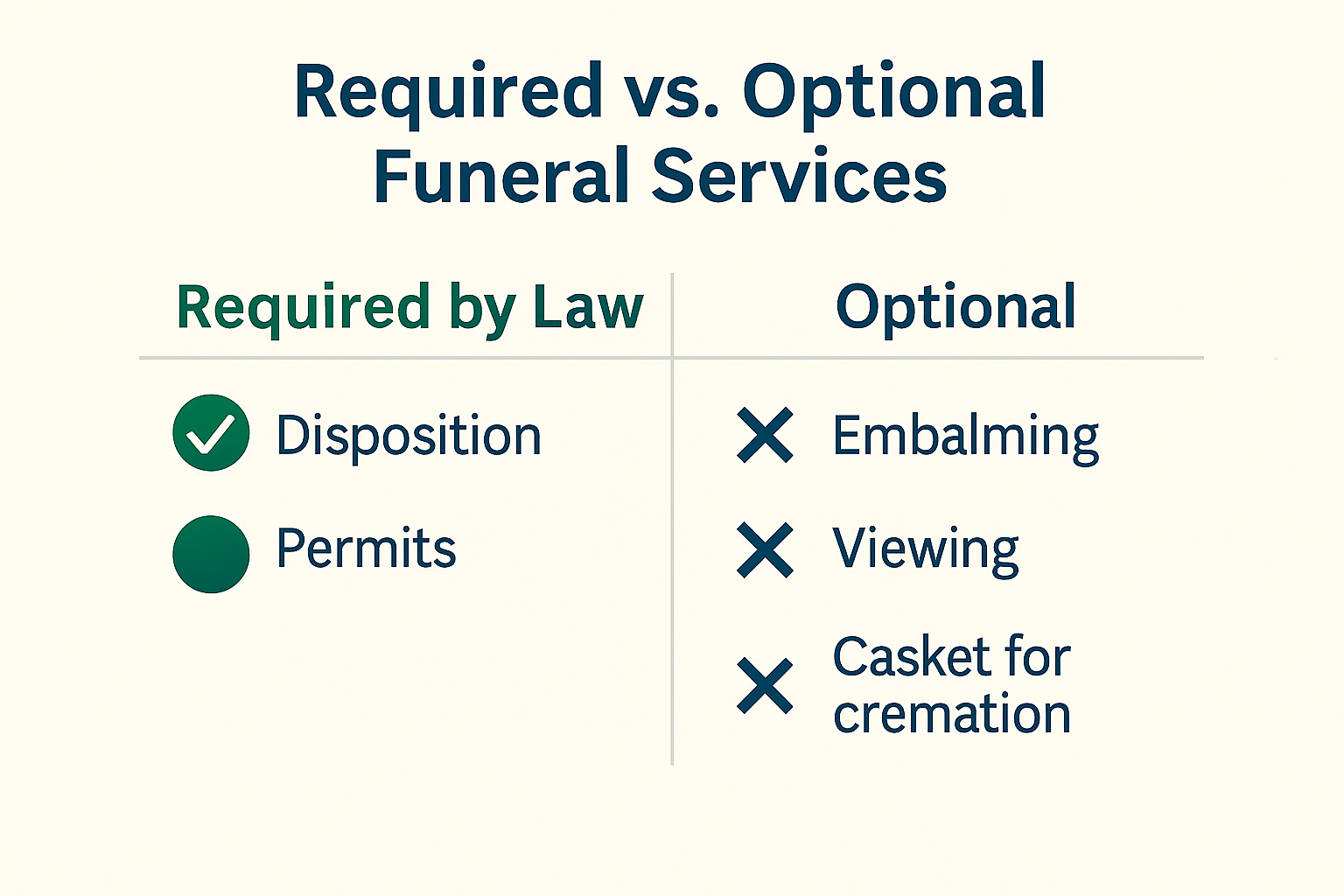
Everything that is not the basic services fee is a choice, and the Funeral Rule protects your right to say no to each one individually. The list below covers what families most often pay for without realizing they were allowed to decline it.
- Embalming. No state law requires routine embalming. A funeral home may require it for a public viewing with an open casket, and some require it if the body will not be refrigerated within a set number of hours, but it is not legally mandatory for a burial or a cremation. At Price Funeral Chapel in Sacramento, embalming is $1,200 and limited physical care, which is washing, disinfecting and dressing without embalming, is $400. That is an $800 decision on a single line.
- A casket for cremation. A crematory cannot require a casket. An alternative container of cardboard or unfinished wood is legal everywhere and costs a fraction of a casket.
- Handling fees on outside merchandise. This one matters. If you buy a casket or urn from anywhere other than the funeral home, the funeral home must accept it and may not charge you a fee for handling it. That is federal law, not a courtesy.
- Viewing, visitation and ceremony facility use. Each is a separate line and each is optional.
- Outer burial containers. No state requires a vault or grave liner. Individual cemeteries often do, as a private policy, and you are entitled to know that before you buy.
- Extras nobody itemizes out loud. Register books, memorial cards, acknowledgment cards, obituary placement, additional limousines. Golden Gate lists an additional limousine at $125 and a range of specialty vehicles up to $2,000.
Saying no to a line item is not disrespectful and it does not mean you loved the person less. It means you read the document you were legally given. Our guide to the FTC Funeral Rule and your consumer rights covers what a funeral home must do, what it may not do, and how to report a violation.
Merchandise Costs: Caskets, Vaults and Urns
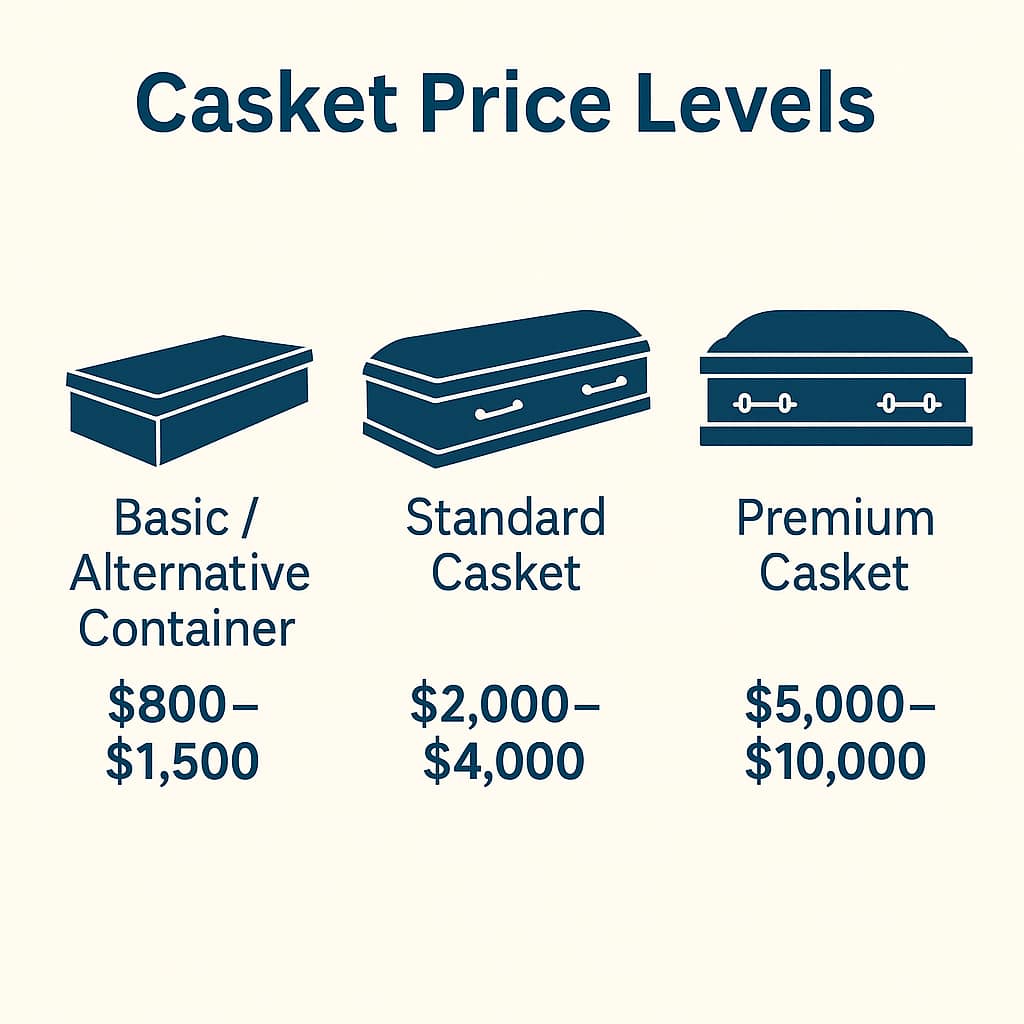
Merchandise is where funeral home pricing stops resembling a service bill and starts resembling retail, because that is what it is. Golden Gate Funeral Home publishes a casket range running from $595 to $60,000 and an outer burial container range from $500 to $40,000. At Price Funeral Chapel, an immediate burial costs $2,395 if you supply the casket yourself and $3,945 if you buy theirs, which prices the casket decision alone at $1,550 on an otherwise identical service.
The Funeral Rule guarantees your right to buy a casket from any source and have the funeral home accept it without a handling fee. That right is worth stating in dollars rather than principles, because a right nobody uses is not protection.
Our partner Discount Caskets publishes their floors openly, verified in August 2026: pine, eco and cremation caskets from $995, metal from $1,175, eighteen and twenty gauge steel from $1,195, oversized from $1,695, Batesville from $1,760, wicker from $1,895, and military caskets from $2,695. Delivery is free to any funeral home in the lower 48 and arrives in two to three business days, which is inside the window nearly every service is scheduled in. The rest of our verified partner codes and offers, all dated, live in the Family Savings Center. If price is the deciding factor right now, their caskets under $1,000 collection is the fastest place to start, and our casket and urn reviews compare specific models against funeral home showroom pricing.
Urns follow the same pattern. A crematory or funeral home will sell you one, and you are under no obligation to buy it there. You can also wait. Ashes are returned in a sealed temporary container that is perfectly adequate for weeks or months while you decide, and deciding slowly usually means deciding better.

Service Fees: Preparation, Facilities, Staff and Transportation
These lines cover the work between the moment someone passes and the moment the service ends, and they are the ones families are least equipped to evaluate because they have never seen them before.
Preparation of the body appears as several separate lines, and separating them is what protects you. From the Sacramento price list: embalming $1,200, limited physical care $400, special care necessitated by autopsy or organ and tissue donation $300, use of the operating room for a medical examination $700, and surgical removal of a pacemaker $200. That last one is not optional if the body is being cremated, because a pacemaker battery will explode in a retort, and it is a legitimate charge.
Facility and staff lines cover the visitation room, the chapel, and staff time on the day. A funeral home with a large building charges more for it, and the same service held at a church or a graveside is usually cheaper for exactly that reason.
Transportation splits into three: transfer of remains into the funeral home’s care, the hearse, and family vehicles. Transfer is close to unavoidable. The hearse and the limousines are not. Mileage beyond a set radius is a common surprise line, and it is worth asking where the radius ends before you agree to a cemetery on the other side of the county.
Cemetery and Crematory Costs, and Why They Are Not on the Price List
The single most common shock in this process is discovering that the funeral home’s price list does not include the cemetery. They are separate businesses with separate bills, and a family that budgeted from the funeral home quote alone is short by thousands.
Cemetery costs typically include the plot itself, the opening and closing of the grave, a required outer burial container if that cemetery’s policy demands one, and the marker or headstone with its own setting fee. Crematory costs are usually folded into a direct cremation price, but not always. The Cleveland Memorial Society notes in its own price survey that some funeral home price lists exclude the crematory fee entirely, and that families should add roughly $300 when comparing.
Ask both questions early. What is on your price list, and what will I be billed for separately. A funeral director who answers that plainly is telling you something useful about how they operate.
What Cremation Actually Costs, and Why the Range Is So Wide
Cremation is now the majority choice in the United States, and it is the line where the gap between the cheapest and the most expensive provider is widest.
The Funeral Consumers Alliance of Georgia collects and publishes General Price List figures for 231 funeral establishments in that one state. Reading their data in August 2026, direct cremation across those 231 funeral homes runs from a low of $800 to a high of $4,160, with a median of $2,145. Immediate burial across the same set runs from $1,745 to $7,500, with a median of $3,710.
Read that first range again. Inside a single state, for a service with no viewing, no ceremony and no casket, the price varies by more than five times depending on which phone number a family happens to call first. Nothing about the service itself differs. What differs is who you called.
Memorial Merits gathered its own figures independently across all 51 state funeral home directory pages, and found a national typical direct cremation cost of $2,295, a median verified low of $985, a lowest verified price of $485 in Washington, and 31 states with at least one licensed provider under $1,000. Two datasets, built by different people using different methods, landing within $150 of each other on the typical price. Our full state by state breakdown lives on the cremation costs hub, including what the lowest verified provider charges in your state.
For families who are planning ahead rather than arranging today, a membership can hold a price against future increases. Cremation Club is the option we point planners toward most often, starting at $4.99 a month with a guaranteed cremation price, and the code MEMORIAL10 takes ten percent off monthly and annual plans.
Why Two Funeral Homes Quote Different Prices for the Same Service
Nothing above is evidence of wrongdoing. Funeral homes are small businesses with wildly different cost structures, and the reasons a price list runs high or low are mostly boring.
Facility size and ownership are the biggest drivers. A funeral home with a 300 seat chapel, a large parking lot and a fleet of vehicles carries that overhead into every line on its price list, whether or not you use the chapel. Corporate ownership tends to raise prices, family ownership tends to lower them, though there are exceptions in both directions. Regional labor and real estate costs move the whole list up or down. Volume matters too: a funeral home handling 400 services a year can price lower than one handling 60.
Then there is packaging. Some funeral homes push package pricing because it is simpler for grieving families and better for margins. Others itemize because they compete on price. A package that looks expensive may contain items you actually want, and a low package may exclude the cemetery, the vault, the death certificates and the crematory fee. The only way to compare two quotes honestly is to compare the same line items on both price lists, which is why you take the documents home.
Our free funeral cost calculator exists for exactly this. It builds an estimate from the choices you actually make rather than a national average, so you can walk into an arrangement conference with a number you trust and a list of what you are willing to decline.
Direct Cremation and Immediate Burial: The Two Floors
Every price list has a floor, and there are two of them.
Direct cremation is cremation with no viewing, no ceremony beforehand and an alternative container instead of a casket. Immediate burial is burial with no viewing and no ceremony at the funeral home. Both include the non-declinable basic services fee, transfer of remains, and the disposition itself. Neither one prevents you from holding a memorial service afterward, at a church, at home, at a park, on your own schedule, at whatever cost you choose.
That last sentence is the part families are rarely told. Choosing a floor option is not choosing to skip the goodbye. It separates the disposition, which is a logistics problem with a price, from the memorial, which is a human event you control completely. Many families find that separating the two gives them a better service, held weeks later when people can actually travel, for a fraction of the cost.
Is It Cheaper to Have a Funeral at a Church or a Funeral Home?
Usually yes, and sometimes by a wide margin, though the saving is smaller than people expect and it comes from a specific place.
Holding the service at a church removes the funeral home’s facility and staff charges for the ceremony itself, which commonly run several hundred to well over a thousand dollars. Many churches ask only a modest donation or a fee for the organist and custodian, and some ask nothing of members. What you do not remove is the basic services fee, the transfer, the preparation, the casket, the hearse to the church, or the cemetery costs. Those follow you regardless of the venue.
There is also a coordination charge to watch for. Some funeral homes bill a separate line for staff attendance at a service held somewhere else, which claws back part of the saving. Ask for that line by name before you assume a church service is cheaper on your particular price list.
What Is the Cheapest Funeral You Can Get?
The honest answer is that the cheapest lawful arrangement in the United States is a direct cremation, and the price depends almost entirely on which provider you call.
From the data above: $800 at the lowest of 231 Georgia funeral homes, $485 at the lowest verified provider in Washington state, and at least one licensed provider under $1,000 in 31 states. Against a national typical of about $2,295, that gap is not a rounding error. It is the difference between a bill a family can absorb and a bill that becomes a debt.
Below direct cremation there are two further options most people never hear about. Whole body donation to a medical school or an accredited research program is free in most cases and includes cremation and the return of ashes to the family afterward, though acceptance is never guaranteed and cannot be relied on as a plan. And every county in the United States has some form of indigent or county burial provision for families who genuinely cannot pay, which is covered alongside the other programs on our funeral assistance programs page.
There is no shame anywhere on that list. A service does not measure love, and a family that spends less is not honoring someone less.
When a Funeral Home Offers a Payment Plan
Funeral homes increasingly offer to spread the bill, and this is the part of funeral home pricing almost nobody has written down accurately.
The FTC Funeral Rule governs disclosure of prices. It states plainly that it does not address the manner or timing of payment, which means the Funeral Rule gives you no protection at all on financing terms. That protection comes from a different place. Under Regulation Z, which implements the Truth in Lending Act, a creditor is defined as a party who regularly extends consumer credit that is subject to a finance charge or payable by written agreement in more than four installments. A funeral home offering you payments over more than four installments, or charging interest, meets that definition. It is a creditor, and it owes you the written disclosures a creditor owes: the annual percentage rate, the finance charge, the amount financed and the total of payments.
Ask for those four figures in writing. A funeral home doing this properly will hand them over without hesitation. If the answer is vague, or the terms are described only verbally, that is the moment to compare against an outside option rather than sign at the arrangement table. Our review of funeral home payment plans and funeral loans covers what the outside options actually cost.
Before borrowing anything, exhaust the free routes first. That order matters more than the interest rate.
Reading a Price List Before You Sign
Take the list home if you can. If you cannot, or if arrangements are happening today, work through it in this order.
- Find the basic services of funeral director and staff line and write the number down. That is your floor at this funeral home.
- Cross off every line you have not chosen. Make them add items back, rather than removing items from a package.
- Ask which items are not on this list and will be billed separately. Cemetery, vault, crematory fee, death certificates, obituary placement.
- Ask whether embalming is required for what you have chosen, and if the answer is yes, ask which specific arrangement makes it required.
- If you are supplying a casket or urn from elsewhere, say so early and confirm out loud that there is no handling fee. There cannot be one.
- Ask for the total in writing before signing anything. The Funeral Rule entitles you to an itemized written statement of goods and services selected.
The FTC’s own funeral costs and pricing checklist is a useful companion to carry in. Our free funeral planning downloads include a printable version you can write on at the table, and if you are in the first hours of this, the first 24 hours checklist covers what has to happen before pricing becomes the question. Every free checklist and worksheet Memorial Merits publishes is listed on the free resources page.
Help Paying for a Funeral
If the number in front of you is larger than what you have, take the free routes before the borrowed ones. In that order, families consistently end up paying less and owing less.
Start with money you may already be owed. Social Security pays a lump sum death benefit to an eligible surviving spouse or child. The VA provides burial allowances, a free plot in a national cemetery, and a headstone or marker for eligible veterans. Employers, unions and fraternal organizations frequently carry small death benefits nobody remembers. Existing life insurance, credit union policies and accidental death riders on an auto or employer plan all get missed. Every one of these is money that already belongs to the family.
Next, a free memorial fundraiser. Ever Loved lets you build a memorial page and collect contributions at no cost, and people who want to help usually have no idea how, so a link answers the question for them. Costing nothing and often producing money within days makes this the first call rather than the last.
Then look at what the arrangement itself can change. Moving from a full service to a direct cremation with a memorial held later, supplying your own casket, or calling two more funeral homes will move the number further than any financing will.
Only after all of that does borrowing make sense. Our financial resources hub collects the assistance programs, the charities that fund specific circumstances, and the survivor benefits in one place, and our guide to the hidden costs families do not see coming covers what tends to appear after the first quote.
The Bottom Line on Funeral Home Pricing
The average funeral cost is a real number and it is close to useless to you. It is the middle of a range that runs from a few hundred dollars to tens of thousands, drawn from a survey that is now years old, and it cannot tell you what the funeral home three miles from your house charges for a fee you are not allowed to refuse.
What can tell you that is a document federal law already guarantees you, handed over before you agree to anything, itemized, and yours to take home and compare. One phone call to two more funeral homes, asking one question about one line item, is worth more than every national average ever published.
You are not being cheap by asking. You are doing the last practical thing you can do for someone, carefully, at a moment when almost nothing else is in your control. Getting it right leaves you something the scramble was going to take: money that stays with your family, and hours that belong to grieving instead of arithmetic.
Additional Resources
- Funeral Cost Calculator, build an estimate from your own choices rather than a national average.
- Cremation costs by state, the lowest verified provider and the typical price in all 51 directories.
- Funeral home directory, licensed providers and local pricing in your state.
- The FTC Funeral Rule, what a funeral home must do, may not do, and how to report a violation.
- Hidden funeral costs, the charges that appear after the first quote.
- Funeral assistance programs, survivor benefits, charities and county provisions in one place.
- Free funeral planning downloads, printable checklists you can write on at the arrangement table.
- The FTC funeral costs and pricing checklist, the federal government’s own comparison worksheet.

|
As Featured In
CBS · ABC · Fox · AP · Business Life Magazine · The New York Telegraph · Insider Weekly · Tampa Bay Observer · Benzinga · SociologyGroup.com · Animal Hospice Group · MemoriaSky.com
Member in the Spotlight, Home Funeral Alliance · Cake.com Professional Directory · Cited by Google AI Overviews
|