
Home › Legacy & Estate Planning › Probate Guide › Letters of Administration
How to Get Letters of Administration When There Is No Will
The bank will not talk to you. That is usually how this starts. You call about your mother’s checking account and someone you have never met tells you they need to see letters of administration before they can say another word.
Letters of administration are a short order from a probate court naming you as the person allowed to handle the estate of someone who died without a will. Until you hold them, no bank, insurer, or county office will move. Lawyers call an estate with no will an intestate estate, which simply means the person died without leaving one.
Here is the part almost nobody tells you before you start. You may not be the person your state allows to do this.
Every state writes a ranked list into law deciding who has the first right to be appointed, and in three states a surviving spouse is not automatically at the top of it. In 32 of the 51 jurisdictions the court will also require you to post a bond before it hands you anything. And if you live in another state, one state bars you outright.
This page answers the three questions that decide whether you can do this at all: whether you outrank your own family, what the court will charge you before it says yes, and whether living out of state stops you. Every figure below is traced to a state statute or to a surety company that actually sells the bond.

Letters of administration are a probate court order naming you as the person allowed to settle the estate of someone who left no will. Your state decides who may ask for them, using a ranked list written into law. The family does not get to choose among themselves.
- What the court charges: Filing fees typically run $50 to $450 depending on the county and the size of the estate.
- The cost people do not expect: Most states require a bond before the court hands anything over, and the floor runs $100 to $175 a year for as long as the estate stays open.
- How long it takes: Four to twelve weeks from filing to letters in hand in an uncontested estate.
- How the ranked list works: A surviving spouse usually sits first, then adult children, then parents, then siblings. Someone lower on the list needs the people above them to decline in writing.
- What changes if there was a will: You need letters testamentary instead, which is a different filing with a different form, even though the authority it grants looks the same.
Can Anyone Get Letters of Administration?#
No. Your state decides, and it decided long before your family started talking about it.
Every state publishes a priority order, which is a ranked list of who has the right to ask the court to be appointed. The person higher on that list outranks everyone below them, and the court follows the list rather than the family’s preference. In most states the order starts with the surviving spouse, then the adult children, then the parents, then the siblings, and then whatever relatives remain.
Most states, but not all, and the exceptions are the ones that surprise people.
Louisiana does not automatically prefer the spouse. Its law tells the court to appoint whoever is “best qualified” among the spouse, the heirs, and the legatees, judged on the person’s ability to actually manage the estate.
Virginia runs on a clock instead of a family ladder. For the first 30 days after the death only a sole distributee may qualify, after 30 days any distributee who applies may qualify, and after 60 days a creditor or any other person can step in.
Wisconsin publishes no family ladder at all for an estate with no will. The court simply appoints any interested person it finds suitable.
The length of the list varies more than you would expect. California publishes 18 separate tiers, running all the way down to the children of a predeceased spouse. Wisconsin and Rhode Island publish two.
The other thing that catches families is the clock. Eighteen jurisdictions put a deadline on your priority, meaning a relative who waits can lose the right to be appointed even though they were first in line.
Iowa is the tightest in the country: the surviving spouse has 20 days from the death, and each class after that gets 10. North Carolina runs 30 days, then a 20 day notice, then a 90 day cutoff after which the clerk can declare every prior right renounced. Alabama and New Jersey use 40 days. Kentucky and Delaware use 60.
If you are the one who is going to do this, do not wait for the family to reach consensus. Find your state below, note the deadline, and file. A probate administrator who files on time keeps the choice in the family’s hands rather than the court’s.

Can You Serve as Administrator If You Live in Another State?#
This is the question the rest of the internet does not answer, and it stops more people than the priority order does.
The adult child who moved away is the most common person trying to settle a parent’s estate. Whether she can do it depends entirely on which state the parent died in, and the answers fall into five groups.
Eighteen jurisdictions place no restriction on you at all. Alaska, Arizona, Colorado, Georgia, Hawaii, Idaho, Maine, Massachusetts, Michigan, Minnesota, Montana, Nebraska, New Mexico, North Dakota, Oregon, South Carolina, South Dakota and Utah will appoint an out-of-state relative the same as a local one.
Nineteen require a resident agent. That means you name a person who lives in that state to accept legal papers on your behalf, and you file that appointment with the court. It is a form, not a barrier. Arkansas, Connecticut, Delaware, District of Columbia, Indiana, Kansas, Louisiana, Maryland, Missouri, New Hampshire, North Carolina, Oklahoma, Rhode Island, Tennessee, Texas, Vermont, Virginia, Washington and Wisconsin work this way.
Three require a resident co-administrator. Iowa, Nevada and Wyoming want an actual person in-state serving alongside you, not just an address for mail. That is a harder ask, because you have to find someone willing to take on the legal duty with you.
Two will only let you serve if you are blood family. Florida admits an out-of-state person only if they are related to the person who died by blood, adoption, or marriage to such a relative. Kentucky does the same. In both states an out-of-state friend, an unmarried partner, or a professional cannot qualify, no matter how close they were.
Ohio says no. Ohio law requires the administrator of an estate with no will to be an Ohio resident, and requires the court to remove anyone who stops being one. The exception written into that statute covers executors named in a will and trustees, not administrators of estates without one.
If your parent passed away in Ohio and you live anywhere else, you cannot be appointed. What you can do is ask an Ohio relative to serve, or ask the court to appoint a suitable Ohio resident, and there is no penalty for finding this out now rather than after you have filed.
Alabama and West Virginia are close to prohibitions in practice. Alabama will not appoint a non-resident unless that person is already the qualified representative of the same estate in another state. Pennsylvania and Mississippi give the court discretion to refuse a non-resident even where nothing forbids it outright, and New Jersey requires a bond in every intestate administration regardless of where you live.
Find the state where your loved one lived, not the state where you live. That is the one that decides.
You are treated the same as a local relative. Nothing extra to file.
Alaska, Arizona, Colorado, Georgia, Hawaii, Idaho, Maine, Massachusetts, Michigan, Minnesota, Montana, Nebraska, New Mexico, North Dakota, Oregon, South Carolina, South Dakota, Utah
You name someone living in that state to accept legal papers for you, and file it with the court. A form, not a barrier.
Arkansas, Connecticut, Delaware, District of Columbia, Indiana, Kansas, Louisiana, Maryland, Missouri, New Hampshire, North Carolina, Oklahoma, Rhode Island, Tennessee, Texas, Vermont, Washington, Wisconsin
Not just a mailing address. An actual person in that state has to serve alongside you.
Iowa, Nevada, Wyoming
Related by blood, adoption, or marriage to such a relative. An out-of-state friend or unmarried partner cannot serve.
Florida, Kentucky
Alabama and West Virginia are near-total bars. Pennsylvania and Mississippi leave it to the court. California limits who you may nominate. Illinois requires US residence. New York restricts non-citizens.
Alabama, California, Illinois, Mississippi, New Jersey, New York, Pennsylvania, Virginia, West Virginia
Ohio Rev. Code 2109.21(A) requires the administrator to be an Ohio resident. If you live anywhere else you cannot be appointed, and there is no workaround. Ask an Ohio relative to serve, or ask the court to appoint a suitable Ohio resident.
Ohio
What Is a Letter of Administration, and What Does It Let You Do?#
A letter of administration is the court’s written proof that you have authority over someone’s estate. Banks, brokerages, insurers, the DMV, and the county recorder will all ask to see it, and most will want a certified copy issued within the last 60 to 90 days.
What it lets you do is specific. You can open an estate bank account, close the accounts that belonged to your loved one, collect money owed to them, sell or transfer property that belonged to them alone, pay the estate’s legitimate debts, file the final tax return, and eventually distribute what is left to the heirs. When the property is real estate, the instrument that actually moves it is a personal representative deed, and it recites these letters on its face.
What it does not do is make the money yours. You are holding it for the estate. That distinction matters more than any other sentence on this page, and it is the reason the bond in the next section exists.
It also has nothing to say about assets that already have a named beneficiary. Life insurance, retirement accounts, payable-on-death bank accounts, and property held in joint tenancy pass directly to the named person without going through probate at all. If everything your loved one owned falls into that category, you may not need letters of administration in the first place.
Letters of Administration vs Letters Testamentary#
These two documents do the same job. The difference is whether there was a will.
When someone leaves a will naming an executor, the court issues letters testamentary to that named person. When there is no will, the court picks someone from the statutory priority order and issues letters of administration instead. Same authority, same acceptance at the bank, different door.
Administrator vs Executor: Is There Any Real Difference?#
The titles describe how you got the job, not what the job is. An executor was chosen by the person who wrote the will. An administrator was chosen by a judge. Once appointed, the duties are close to identical, and estate administrator duties look the same as an executor’s: inventory the assets, notify the creditors, pay what is owed, and distribute the rest.
Two practical differences do follow from the missing will. A will usually waives the bond requirement, and an estate with no will has nothing to waive it, which is why a probate administrator is far more likely to be required to post one. And a will says who inherits, while an estate without one is distributed under your state’s intestate succession law, which may not match what your loved one would have wanted.

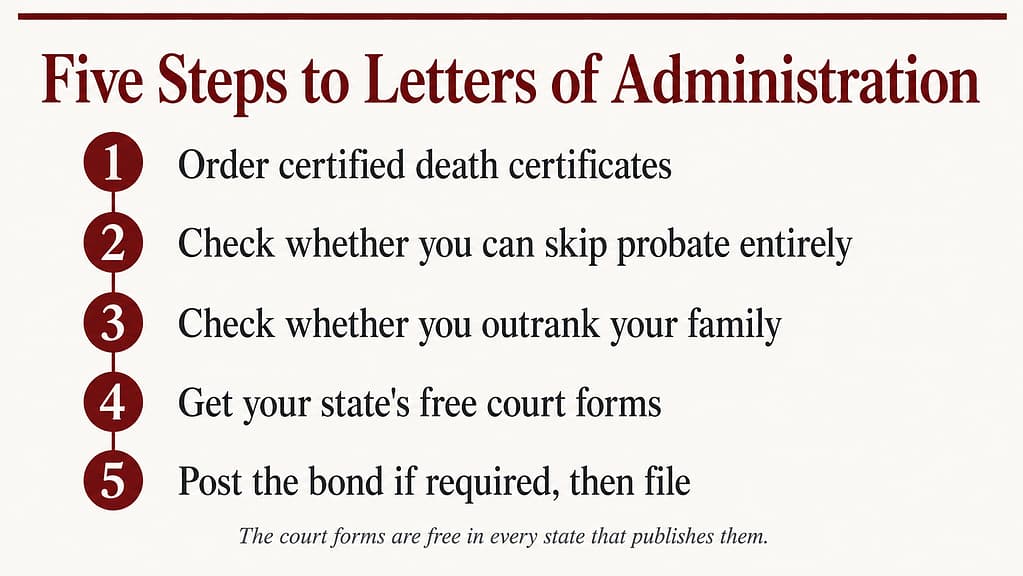
How to Get Letters of Administration in 5 Steps#
Time needed: 84 days
How to Get Letters of Administration: Five steps to be appointed administrator of an estate when someone died without a will, from ordering death certificates through collecting your letters from the probate court. Time needed: 4-12 Weeks Estimated Cost: $150
- Order certified copies of the death certificate
Order five to ten certified copies from your state or county vital records office, not from the court. Every bank and insurer wants an original with a raised seal and none of them give it back. Expect about $20 for the first copy and a few dollars for each additional one.
- Find out whether you can skip probate entirely
Every state has a simplified path for smaller estates. If the estate fits under your state’s limit you may be able to collect everything with one sworn affidavit and never open a probate case. Our free probate cost calculator gives you your state’s limit, the waiting period, and whether owning real estate disqualifies you.
- Find out whether you outrank your family
Your state publishes a ranked priority order deciding who has the first right to be appointed. Check where you sit, and check the out-of-state rules if you do not live where your loved one did. If someone ahead of you is willing to step aside, most states let them sign a free written renunciation. Compare your position against letters testamentary if a will later turns up.
- Get your state’s forms and fill them out
The application is free from the probate court and no company sells a version any court will accept. Ohio requires eight separate forms, California seven, New York nine. Download the full set for your state, and check whether your county adds its own coversheet. If you qualify to skip probate instead, a small estate affidavit replaces this whole step.
- Post the bond if required, then file
Thirty two of the fifty one jurisdictions require a bond before the court will issue anything. Buy it from a surety company, then file everything with the probate court in the county where your loved one lived. After a short hearing in most states, the court issues your letters. Start from our probate guide if you want the wider process.
What Documents Do I Need for a Letter of Administration?#
This is where the free route gets genuinely hard, and it is not because the forms cost money. It is because no state hands you a list of which ones apply to your family.
It is almost never one form. Here is what the states that publish complete sets actually require to get you appointed:
Find your state, then count. If the number surprises you, that is the point: no state hands you this list.
| State | Forms to get appointed | Free online? | Instructions from the state? |
|---|---|---|---|
| Ohio | 8, plus one waiver and one notice per relative who outranks or ties you | Yes, all fillable | None. Counties add their own forms. |
| California | 7. The petition alone has 199 fields | Yes, all fillable | Good guide, but it never lists the other six forms |
| Michigan | 9 simple, up to 14 with waivers and bond | Yes, all fillable | Best in the country. Wayne County posts a video per form. |
| New York | 9 | Only about half. The rest come from your county. | Checklists yes, no guided program |
| Texas | No statewide forms exist | No | An attorney is required in practice |
| Florida | No free state forms | No | An attorney is required by court rule |
| Virginia | Not a download | No | You qualify in person at the clerk’s counter |
| New Jersey | Not a download | No | The Surrogate’s clerk drafts the papers for you |
Ohio takes eight separate forms, and you file an extra waiver and an extra notice for every relative who ranks equal to or above you. The Supreme Court of Ohio publishes all of them free and fillable, with no instructions of any kind. Individual counties then add their own forms on top, and some will not accept handwriting.
California takes seven. They are all free at the California courts self-help site, which is the clearest plain-English guide any state publishes. It still tells you to file the Petition for Probate “along with other court forms” without ever listing them. That petition alone has 199 fields.
Michigan takes nine for a simple case and up to fourteen with waivers, bond, and creditor notice. All are free and fillable, and Wayne County publishes a walkthrough video for each individual form, which is the best free help in the country.
New York takes nine, and only about half are published statewide. The Surrogate’s Court forms page carries the petition and a checklist; the citation, the waiver, the decree and the affidavits of service come from your individual county.
Texas and Florida are different in kind. Texas publishes no statewide probate application at all, and both Harris and Travis County probate courts hold that a non-lawyer preparing those papers while acting as a fiduciary is practicing law without a license. Florida requires an attorney by court rule for every personal representative except one who is the only interested person. In both states this is not a form problem, it is a representation requirement.
Virginia and New Jersey cannot be downloaded. In Virginia you make an appointment and qualify in person at the circuit court clerk’s counter. In New Jersey the county Surrogate’s clerk interviews you and then drafts the application, the affidavit of assets, the qualification, the bond and the renunciations for you to sign. There is nothing to fill out in advance.
Beyond the court forms, plan on certified death certificates, a list of the estate’s assets and debts, and the bond if your state requires one. Everything else the court needs, the court supplies.
Will You Need a Probate Bond, and What Does It Cost?#
A probate bond is not a fee and it is not a deposit. It is an insurance policy that pays the heirs back if you mishandle the estate’s money. Sellers also call it an administrator bond, an estate bond, or a fiduciary bond, and they all mean the same thing.
The court requires it because you are about to control funds that belong to other people. You are not buying protection for yourself; you are buying protection for them, and that is exactly why the court trusts you with the letters afterward.
Thirty two of the 51 jurisdictions require one by default. Fourteen do not require it unless someone asks or the will demands it. Five leave it to the judge.
Illinois shows why an estate with no will gets caught most often. Illinois law excuses the security only when a will excuses it, and an intestate estate has no will to do the excusing, so an Illinois administrator posts bond as a matter of course.
Now the number, because it is almost certainly not what you are imagining.
Find the row closest to the estate’s value. These are published rates from four sellers, shown as a spread rather than an average, because your state and your credit move the number.
| Bond amount | Jet Insurance (New York) | Ohio program rate | Texas seller, good credit |
|---|---|---|---|
| $50,000 | $260 | $125 | $150 to $250 |
| $100,000 | $460 | $250 | $500 |
| $250,000 | $985 | $625 | $1,250 |
| $500,000 | $1,610 | $1,250 | $2,500 |
| $1,000,000 | $2,110 | Rate not published | $5,000 |
Every seller found sets a floor of $100 to $175 per year, so a small estate never costs less than that. The premium renews annually until the court discharges you, and the first year is not refundable.
The floor is $100 to $175 a year. Jurisco and Jet Insurance both set a $100 minimum, Jane Bond Surety sets $175.
For a $50,000 estate the published premiums run between $125 and $400 depending on the state and the seller. For a $250,000 estate they run between $625 and $2,500. Those are ranges rather than averages, because the spread is real and depends on your state and your credit.
Three facts about the probate bond cost matter more than the rate table:
Most people are never credit checked. On an administrator bond up to $150,000, sellers do not run credit at all. Below $25,000 several issue instantly. If your own finances are strained right now, and after a death they very often are, this is the sentence to hold onto.
The estate pays it, not you, in the end. Florida, California and Washington all put the premium in statute as a lawful expense of administration. The practical wrinkle is that you usually have to front it, because the bond has to be filed before the court issues letters, and before you have letters you cannot touch the estate’s accounts. You pay, then you claim it back when you file your accounting.
It renews every year and the first year is not refundable. An estate bond is written for a twelve month term and renews until the court discharges you.
A $250,000 estate that closes in one year costs about $985. The same estate stuck in a three year probate costs about $2,955. Closing the estate promptly is worth real money, and it is the strongest argument for getting the paperwork right the first time.
If your credit is poor you can still be approved, usually at a higher rate through a surety that specializes in it, and personal property can sometimes be pledged as collateral. Being declined outright is possible, and if it happens the judge appoints someone else rather than leaving the estate stranded.

Administrator Appointment Priority in Every State#
Find your state, read your line, and note the deadline if there is one. Every entry is cited to the statute it came from so you can take it to the court or to a lawyer and have it hold up. If you do not have a lawyer to take it to, a membership plan is the cheapest way to get one on the phone about an estate you are already administering, and we work through whether LegalShield is worth it for exactly that situation.
Find your state. Column two is who the law puts first when there is no will. Column four is whether you can serve from out of state. Every entry is cited to the statute so you can take it to the court.
| Jurisdiction and statute | Who ranks first | Bond required? | Out-of-state administrator |
|---|---|---|---|
| Alabama Ala. Code 43-2-42 | The husband or widow | Yes, by default | Conditions apply |
| Alaska Alaska Stat. 13.16.065 | The surviving spouse of the decedent | Yes, by default | Yes, no conditions |
| Arizona A.R.S. 14-3203 | The surviving spouse of the decedent | Yes, by default | Yes, no conditions |
| Arkansas Ark. Code Ann. 28-48-101 | The surviving spouse, or the spouse’s nominee, on petition filed… | Judge’s discretion | Resident agent required |
| California Cal. Prob. Code 8461 | Surviving spouse or domestic partner | Yes, by default | Conditions apply |
| Colorado Colo. Rev. Stat. 15-12-203 | A person given priority in a designated beneficiary agreement | Not by default | Yes, no conditions |
| Connecticut Conn. Gen. Stat. 45a-303 | The surviving spouse | Yes, by default | Resident agent required |
| Delaware 12 Del. C. 1505 | Spouse of the decedent | Not by default | Resident agent required |
| District of Columbia D.C. Code 20-303 | The surviving spouse, domestic partner, or children of an intestate… | Yes, by default | Resident agent required |
| Florida Fla. Stat. 733.301 | The surviving spouse | Judge’s discretion | Blood relative only |
| Georgia O.C.G.A. 53-6-20 | An administrator unanimously selected by all the heirs | Yes, by default | Yes, no conditions |
| Hawaii Haw. Rev. Stat. 560:3-203 | The surviving spouse or reciprocal beneficiary of the decedent | Not by default | Yes, no conditions |
| Idaho Idaho Code 15-3-203 | The surviving spouse of the decedent | Not by default | Yes, no conditions |
| Illinois 755 ILCS 5/9-3 | The surviving spouse or any person nominated by the surviving spouse | Yes, by default | Conditions apply |
| Indiana Ind. Code 29-1-10-1 | The surviving spouse, the person nominated by the surviving spouse,… | Not by default | Resident agent required |
| Iowa Iowa Code 633.227, with class timing at Iowa Code 633.228 | The surviving spouse | Yes, by default | Resident co-administrator |
| Kansas Kan. Stat. Ann. 59-705 | The surviving spouse or next of kin, or both, as the court may… | Yes, by default | Resident agent required |
| Kentucky Ky. Rev. Stat. Ann. 395.040 | The relations of the deceased who apply for administration, with the… | Not by default | Blood relative only |
| Louisiana La. Code Civ. Proc. art. 3098, read with art. 3097 | The best qualified among the surviving spouse, the competent heirs… | Yes, by default | Resident agent required |
| Maine 18-C M.R.S. 3-203 | The surviving spouse of the decedent | Not by default | Yes, no conditions |
| Maryland Md. Code, Est. & Trusts 5-104 | Surviving spouse, registered domestic partner, and children of an… | Yes, by default | Conditions apply |
| Massachusetts Mass. Gen. Laws ch. 190B, 3-203 | Surviving spouse of the decedent | Yes, by default | Yes, no conditions |
| Michigan MCL 700.3203 | Surviving spouse of the decedent | Not by default | Yes, no conditions |
| Minnesota Minn. Stat. 524.3-203 | Surviving spouse of the decedent | Not by default | Yes, no conditions |
| Mississippi Miss. Code Ann. 91-7-63 | Surviving husband or wife | Yes, by default | Court’s discretion |
| Missouri Mo. Rev. Stat. 473.110 | The husband or wife | Yes, by default | Conditions apply |
| Montana Mont. Code Ann. 72-3-502 | Custodial parent of a minor decedent | Not by default | Yes, no conditions |
| Nebraska Neb. Rev. Stat. 30-2412 | Surviving spouse of the decedent | Yes, by default | Yes, no conditions |
| Nevada NRS 139.040 | The surviving spouse | Judge’s discretion | Resident co-administrator |
| New Hampshire N.H. Rev. Stat. Ann. 553:2, with preference rules at RSA 553:3 | The widow, husband, or any of the next of kin, or such suitable… | Yes, by default | Resident agent required |
| New Jersey N.J.S.A. 3B:10-2 | Surviving spouse or domestic partner, if he or she will accept | Yes, by default | Resident agent required |
| New Mexico NMSA 1978, Section 45-3-203 | The surviving spouse of the decedent | Not by default | Yes, no conditions |
| New York SCPA 1001 | The surviving spouse | Yes, by default | Conditions apply |
| North Carolina N.C. Gen. Stat. 28A-4-1(b) | The surviving spouse of the decedent | Yes, by default | Resident agent required |
| North Dakota N.D.C.C. 30.1-13-03 | The surviving spouse of the decedent | Not by default | Yes, no conditions |
| Ohio Ohio Rev. Code 2113.06 | The surviving spouse of the deceased, if a resident of Ohio | Yes, by default | NO, barred |
| Oklahoma 58 Okla. Stat. 122 | The surviving husband or wife, or some competent person whom he or… | Yes, by default | Resident agent required |
| Oregon ORS 113.085 | The surviving spouse of the decedent or the nominee of the surviving… | Yes, by default | Yes, no conditions |
| Pennsylvania 20 Pa. C.S. 3155(b) | The surviving spouse | Yes, by default | Court’s discretion |
| Rhode Island R.I. Gen. Laws 33-8-8 | The widow or surviving husband, or one or more of the next of kin,… | Yes, by default | Resident agent required |
| South Carolina S.C. Code Ann. 62-3-203 | Surviving spouse of the decedent | Yes, by default | Yes, no conditions |
| South Dakota S.D. Codified Laws 29A-3-203 | Surviving spouse of the decedent | Not by default | Yes, no conditions |
| Tennessee Tenn. Code Ann. 30-1-106 | Surviving spouse, if the spouse applies for administration | Yes, by default | Resident agent required |
| Texas Tex. Est. Code 304.001 | The person designated as administrator as authorized under Section… | Yes, by default | Resident agent required |
| Utah Utah Code Ann. 75-3-203 (medium confidence) | Surviving spouse of the decedent | Not by default | Yes, no conditions |
| Vermont 14 V.S.A. 903 | Surviving spouse or next of kin, or both, or the person nominated by… | Yes, by default | Resident agent required |
| Virginia Va. Code Ann. 64.2-502 | During the first 30 days after death: the sole distributee, or his… | Yes, by default | Resident agent required |
| Washington RCW 11.28.120 | Surviving spouse or state registered domestic partner, or such… | Judge’s discretion | Resident agent required |
| West Virginia W. Va. Code 44-1-4 | Distributees who apply, preferring first the husband or wife | Yes, by default | Conditions apply |
| Wisconsin Wis. Stat. 856.21 | Any person interested in the estate, or that person’s nominee,… | Judge’s discretion | Resident agent required |
| Wyoming Wyo. Stat. Ann. 2-4-201 | The surviving husband or wife, or some competent person whom he or… | Yes, by default | Resident co-administrator |
A few states are worth reading in sentences rather than in a table row, because the rule is not what anyone expects.
Ohio puts residency inside the priority order itself. The surviving spouse ranks first only if that spouse is an Ohio resident, and the same is true of the next of kin below them.
Georgia lets the heirs override the statutory order entirely. If every heir agrees unanimously on one person, that choice controls, and it beats the list. Georgia is also the most open state in the country on residency, though the bond surety still has to be a Georgia company.
New York generally requires a bond for administrators, and the court can reduce or waive it when you are entitled to the whole estate or when every interested party consents in writing. A non-resident who is a United States citizen may serve, but a person who is neither a citizen nor a New York domiciliary needs a New York co-fiduciary.
Texas puts a designated administrator ahead of the surviving spouse in its order, then the spouse, then the principal devisee, then next of kin. A non-resident must appoint a resident agent and file that appointment with the court before qualifying.
Pennsylvania gives the register of wills discretion to refuse letters to any non-resident, and a non-resident also falls outside the exemption that would otherwise excuse the bond.
California runs the longest ladder in the country at 18 tiers, and while a relative living in another state may serve, anyone that relative nominates to serve in their place must be a California resident.
Can a Small Estate Affidavit Replace Letters of Administration?#
For a great many families, yes, and this is the section worth reading twice.
Every state has a simplified path for estates under a certain value. You sign a sworn statement, wait out a short period, present it to the bank or the transfer agent, and collect the assets without ever opening a probate case. No petition, no hearing, no bond, no letters. Depending on the state, the limits run from a few thousand dollars to over $200,000, and what counts toward the limit differs so much between states that two identical families can get opposite answers.
Michigan closes the path if your loved one owned any real estate at any value. New York does not count real estate toward the limit at all. Arizona counts real estate at the county assessed value in a separate bucket from personal property. California counts everything at full market value and then will not let the affidavit transfer the house anyway.
The probate cost calculator answers this for your state in about a minute, free, and tells you the limit, the waiting period, and whether real estate disqualifies you.
If you qualify, the affidavit itself is often published free by your state court, and we would rather you use the free one.
Ohio publishes its whole set. New York runs a guided program for small estates. TexasLawHelp publishes free guided forms. Check your court first.
Where a free state form does not exist, or where you would rather answer plain-English questions and have a finished document in about seven minutes than assemble one yourself, a guided service is a reasonable choice. We use Legal Templates for this, and we will tell you exactly what it is and is not.
What it is: a guided questionnaire that produces a completed, notary-ready small estate affidavit, downloadable in PDF or Word, stored in your account so you can correct and re-download it, with e-signature included. There is a 7 day free trial and the download works during the trial without a watermark.
What it is not: state-specific in the way the marketing implies. Legal Templates uses one small estate affidavit template for 47 of the 51 jurisdictions, with genuinely separate versions only for Georgia, Kentucky, New Hampshire and Wisconsin. It is also not legal advice, and nobody reviews your document.
Answer plain-English questions and get a finished, notary-ready affidavit in about seven minutes, downloadable in PDF or Word and stored so you can correct it later. The 7-day free trial includes the download.
Build My Affidavit
One more document you may run into: the affidavit of heirship. It is worth knowing what this actually is, because it gets recommended in places it does not belong.
An affidavit of heirship is a real property document, used mostly in Texas, recorded in the county deed records to establish who inherited land. It is used instead of probate, not alongside a petition for letters, and it does not transfer bank accounts or vehicles. If someone tells you that you need one in order to be appointed administrator, they are mistaken.
The Probate Document Finder applies your state’s small estate limit and waiting period, shows whether the estate can use an affidavit instead of letters of administration, and lists each document in the order you will need it.
Do I Need a Lawyer for Probate?#
In two states, yes, and it is not a matter of opinion.
Florida requires an attorney by court rule for every personal representative except a person who is the only interested party in the estate. Texas has no statewide probate application form, and its two largest probate benches hold that a non-lawyer preparing those pleadings while serving as a fiduciary is the unauthorized practice of law. In both states, budget for representation from the start.
Everywhere else it is genuinely optional, and plenty of people do it alone. You are a good candidate to handle it yourself when the estate is straightforward, the family agrees on who should serve, your state publishes a complete form set, and nobody is likely to contest anything.
Get help when any of these are true: the family disagrees about who should be appointed, the estate owns real estate in more than one state, there is a business to run or sell, the debts may be larger than the assets, someone has threatened to challenge the appointment, or you simply do not have the time this takes.
Hourly probate representation commonly runs a few hundred dollars an hour, which puts it out of reach for a lot of families at exactly the moment they need it. A legal plan is the middle option: a monthly membership that includes attorney consultations, document review, and letters or calls made on your behalf. It does not replace a probate attorney for a contested estate, and we would not tell you it does. For a first conversation with a lawyer about you are on the right track, it costs a fraction of an hourly consultation.
Probate representation commonly runs a few hundred dollars an hour, which is out of reach for most families at exactly the wrong moment. A legal plan sits in the middle: a monthly membership that includes attorney consultations, document review, and letters made on your behalf. It will not replace a probate attorney on a contested estate, and we would not tell you otherwise. For a first conversation about whether you are on the right track, it costs a fraction of one hourly consultation.
See Plan PricingWhat Happens to the Estate When There Is No Will#
Being appointed administrator of estate assets does not give you any say in who inherits. That is decided by your state’s intestate succession law, a default will written by the legislature and applied to anyone who did not write their own.
The results regularly surprise people. A surviving spouse does not automatically inherit everything in most states; in many, the spouse splits the estate with the children or with the parents of your loved one. Stepchildren who were never legally adopted usually inherit nothing. Unmarried partners inherit nothing at all, regardless of how long the relationship lasted.
Your job as administrator is to follow that law exactly, even when you disagree with the outcome, and the specific shares vary by state and by which relatives survived.
If you are reading this while planning ahead rather than settling an estate, this is the whole argument for putting something in writing. A transfer on death deed keeps a house out of probate entirely in the states that allow one, and our legacy and estate planning guides cover the rest.
For everything else about the probate process itself, including what it costs and how long it takes, start at our probate guide.
Frequently Asked Questions
Sources and Further Reading
Every figure on this page traces to one of these. Court form links go straight to the free official set, not to a middleman.
Supreme Court of Ohio, Decedent’s Estate Forms. The full standard probate set, free and fillable.
California Courts Self-Help, Probate. Judicial Council forms plus the clearest plain-English guide any state publishes.
Michigan SCAO, Estates and Trusts Forms. Free and fillable, with county-level video walkthroughs.
New York Surrogate’s Court Forms. The petition and checklists; the balance comes from your county.
TexasLawHelp, Transferring Property Without Going to Court. Free guided forms for the routes that avoid probate.
Ohio Rev. Code 2113.06 and 2109.21. Appointment priority, and the residency requirement that bars out-of-state administrators.
Cal. Prob. Code 8461. The 18-tier priority order, the longest in the country.
Fla. Stat. 733.301 and 733.304. Florida priority, and the rule limiting out-of-state service to blood relatives.
Iowa Code 633.227 and 633.228. The tightest clock in the country: 20 days for a surviving spouse.
New York SCPA 1001. Priority among distributees seeking letters of administration.
Tex. Est. Code 304.001 and 304.003. Texas priority order and the resident agent requirement.
Cal. Prob. Code 8486. Confirms the premium is an allowable estate expense for every year the bond stays in force.
Published surety rate schedules from Jet Insurance Company, Jurisco, Jane Bond Surety, Surety Bond Houston, and the CBS Agency program underwritten by RLI. Rates shown on this page are the sellers’ own published figures.
Statutes verified against current code editions in August 2026. Court form links checked live the same month. State law changes; if you find a figure here that no longer matches your court, tell us and we will correct it.

|
As Featured In
CBS · ABC · Fox · AP · Business Life Magazine · The New York Telegraph · Insider Weekly · Tampa Bay Observer · Benzinga · SociologyGroup.com · Animal Hospice Group · MemoriaSky.com
Member in the Spotlight, Home Funeral Alliance · Cake.com Professional Directory · Cited by Google AI Overviews
|