
Home › Legacy & Estate Planning › Probate Guide
Start Here: Find Out If You Need Probate, What It Costs, and What to File
Somebody told you that you have to go through probate. It might have been the bank when they froze the account, or a cousin who went through this two years ago in a different state, or the funeral director filling a pause in the conversation. Nobody told you whether it was true in your state, what it would cost, or how long you would be doing it. So you are here, at whatever hour this is, trying to find out whether the next several months of your life have already been decided for you.
They probably have not been. Probate limits vary so widely that the same estate qualifies for a two page affidavit in one state and a nine month court administration in the state next door, and the range is not close: the cutoff is $15,000 in Rhode Island and $400,000 in Wyoming. Full probate generally consumes 3 to 7 percent of an estate before anyone inherits a dollar of it. A great many families pay that percentage without ever learning they had a shorter road available to them.
I read all 51 sets of rules to build the calculator on this site, and the thing that surprised me was not the spread in the dollar figures. It was that the dollar figure is rarely what decides the case. What decides it is the rule about what counts toward that figure, and no two states agree on it. This guide is the map: what probate is, whether you need it, what it costs, which documents you will be asked for, and where every tool and guide we have built on the subject lives.
Probate only covers assets titled in the deceased person’s name alone with nobody named to receive them. Anything with a beneficiary, a joint owner, or a trust passes outside it entirely. That single rule decides whether your family owes the court a case at all.
- Small estate limits: From $15,000 in Rhode Island to $400,000 in Wyoming, with the waiting period running from none at all in New York to 60 days in the District of Columbia.
- The rule that closes the shortcut: 22 jurisdictions disqualify a small estate the moment the person owned any real estate, at any value. New York does the opposite and does not count real estate at all.
- What full probate costs: Generally 3 to 7 percent of the estate, figured on gross value rather than equity, so a mortgaged house counts at what it is worth rather than what was owned of it.
- Where attorney fees are set by law: In 31 jurisdictions the fee is governed by statute or court rule rather than by the attorney, which is worth knowing before you accept a quote.
- The cheapest move available: Retitle and name beneficiaries while you can. Every asset moved out of the probate estate in advance is one the court never touches.
Do You Even Need Probate? The Three Questions That Decide It#
Probate is the court supervised process of proving a will, paying what the estate owes, and moving what is left to the people entitled to it. It is not automatic and it is not universal. Whether your family owes the court that process comes down to three questions, asked in this order.
First, what did the person actually own in their own name alone? Property with a named beneficiary passes outside probate entirely. Life insurance, retirement accounts, payable on death bank accounts, and anything held in a living trust go straight to the named person without a judge. Property held jointly with right of survivorship usually goes to the surviving owner the same way. What is left, the assets titled in the deceased person’s name with nobody named after them, is the probate estate. That is the only number that matters, and it is almost always smaller than the number families first calculate.
Second, is that number under your state’s small estate limit? Every state but a handful offers a shortened path for estates below a threshold, usually an affidavit or a simplified petition rather than a full administration. The thresholds are not close to each other. Neither are the waiting periods, which run from nothing at all in New York to 60 days in the District of Columbia.
Third, and this is the question almost nobody asks, what counts toward that limit in your state? This is where families get caught. Michigan closes the shortcut entirely if the person owned any real estate at all, at any value, under MCL 700.3983. New York does the opposite and does not count real estate toward the limit at all. New Jersey counts real estate and personal property together against one number, which catches people out constantly. Arizona counts them in two separate buckets so one cannot push the other over, and it values real estate at the county assessed figure rather than what the house would sell for. California counts everything at full market value, including a house with a mortgage on it, and then will not let the affidavit transfer that house anyway.
Four states, four completely different answers to the same question about the same family. The dollar figure gets all the attention. The counting rule decides more cases.
Probate costs land months after the funeral, which is why families who paid for the funeral out of pocket are often the ones least ready for them. If both bills are in front of you, our guide to funeral assistance programs and financial help after a death covers what the family is already owed before anything gets borrowed.
The Probate Document Finder runs these three questions for your state. Pick the state, answer up to seven questions about the estate, and it shows whether the estate needs probate and lists each document in the order you will need it.
What Probate Costs and How Long It Takes#
Probate generally runs 3 to 7 percent of the gross value of an estate, and the percentage climbs when there is real property, a contested will, or property sitting in more than one state. Gross is the operative word. In most states the fee is calculated on what the property is worth, not on what is left after the mortgage, so a $400,000 house with $250,000 still owed on it counts as $400,000 when the bill is figured.
Whether that bill is negotiable depends entirely on where you are standing. In 31 jurisdictions the attorney fee is held to a reasonableness standard, which is another way of saying it is a negotiation, and families who ask for a flat fee in writing before hiring anyone usually pay less than families who never ask. In 11 states the fee comes from a statutory schedule, and arguing about it accomplishes nothing because the number came from the legislature rather than from the lawyer across the table. Court filing fees sit on top of either one and vary from a flat $35 to open in Ohio to sliding scales that run past $1,000.
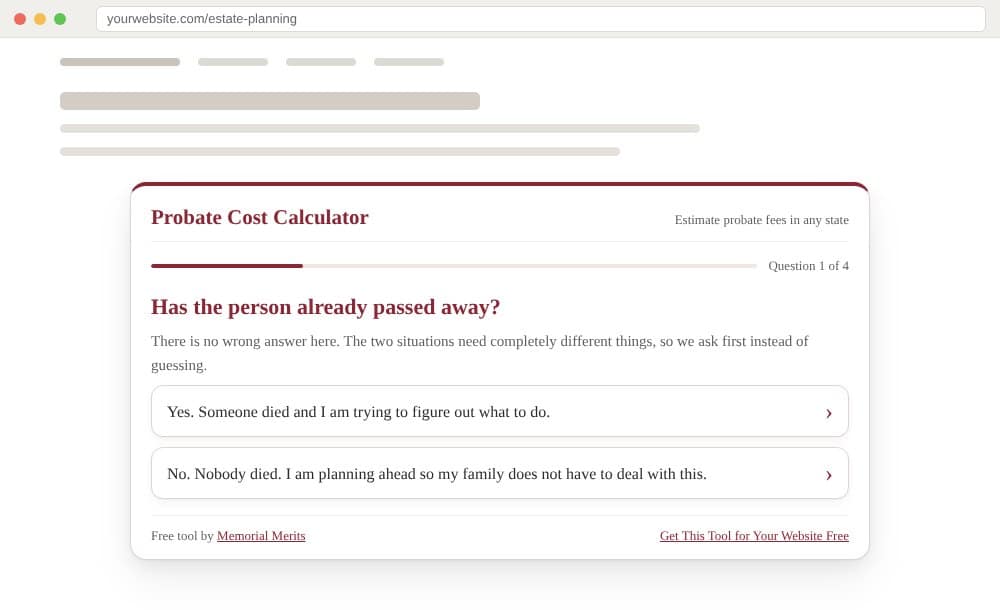
Rather than repeat those numbers here, we built you the tool that returns yours. The free probate cost calculator asks four questions and gives you your state’s attorney fee, executor fee, and court filing fee with the statute cited under each number, plus whether your estate qualifies to skip probate entirely. Nothing is saved, nothing is sent, and there is no email required to see the answer.
<div class="mm-probate-cost-lite" data-ref="card-pc-s">Probate Cost Calculator by <a href="https://memorialmerits.com/how-much-does-probate-cost/">Memorial Merits</a></div><div class="mm-probate-cost-lite" data-ref="card-pc-s">Probate Cost Calculator by <a href="https://memorialmerits.com/how-much-does-probate-cost/">Memorial Merits</a></div> <script src="https://memorialmerits.com/api/tools/probate-cost-lite.js" async></script>
The Four Ways an Estate Skips Probate#
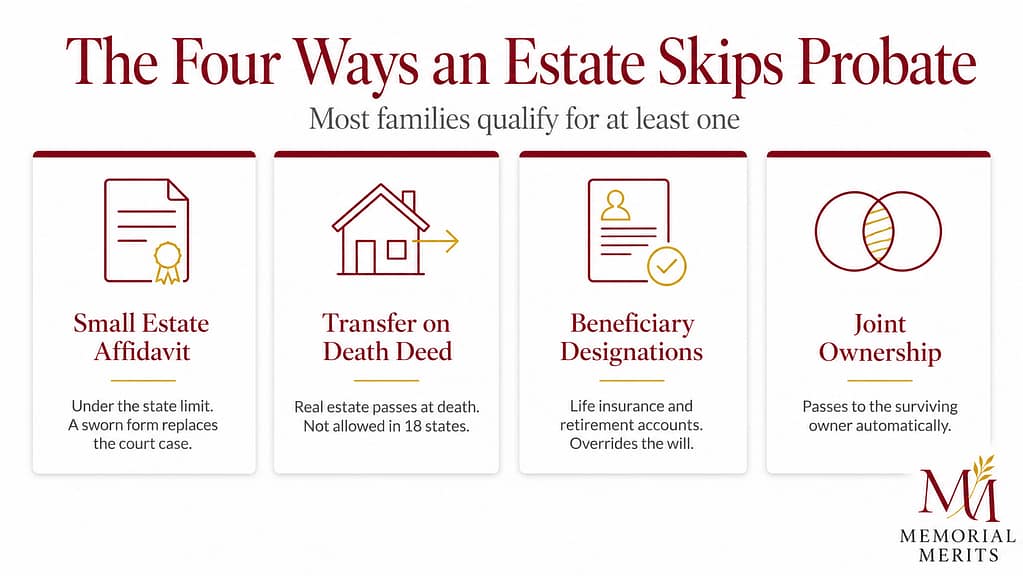
There are exactly four doors out, and most families qualify for at least one without knowing it. Understanding which door is open to you is worth more than any other single thing on this page.
The small estate affidavit or simplified administration. The most common door. If the probate estate falls under the state limit, a sworn form and a waiting period replace the court process. Many states publish the form free rather than making you buy it. New York runs a guided small estate affidavit program at no cost, and the Judicial Branch of California publishes its small estate procedure the same way.
The transfer on death deed. A recorded deed that moves real estate to a named person at death without the property ever entering probate, while the owner keeps full control and can revoke it any time. This is the single most useful planning instrument most homeowners have never heard of, and it is also the most uneven: 17 states do not allow one at all. Maryland is about to change that, with a transfer on death deed taking effect October 1, 2026, which matters if you are planning ahead rather than settling an estate today.
Beneficiary designations. Life insurance, retirement accounts, and payable on death or transfer on death bank and brokerage accounts pass to the named person by contract. They never touch probate, they override what a will says, and they are the most commonly out of date documents in an average household. An ex spouse named on a 401(k) in 2009 still inherits it in 2026 unless somebody changed the form.
Joint ownership with right of survivorship. Property held this way passes to the surviving owner automatically. It is simple, it is free, and it carries real tradeoffs around control and creditor exposure while both owners are alive, which is why it is a planning decision rather than a default.
The Documents and Filings You Will Need#
Probate runs on paper, and the paper has names that mean nothing until the moment somebody demands one from you. Here is what each is and when it appears.
Letters testamentary are the court's order granting the person named in the will the authority to act for the estate. Until you hold them, banks and brokerages will not speak to you about the account, which is the wall most executors hit in their first week. If there is no will, or the named executor cannot serve, the court issues letters of administration instead, which grant the same authority to somebody the court appoints under state priority rules.
A small estate affidavit is the sworn statement that replaces the whole process when the estate is under the limit. An affidavit of heirship establishes who the legal heirs are when there is no will, and it is used most heavily in Texas and the states around it. An affidavit of domicile is the one brokerages ask for before they will release stocks, and most families have never heard of it until a transfer agent refuses them. An affidavit of death clears a deceased joint owner off a property title. The inventory is the estate's accounting of what exists and what it is worth, and in several states the filing fee is calculated from it.
Two practical notes that save real time. First, ask the court for multiple certified copies of your letters at the moment they are issued, because most institutions want an original and many will not accept one dated more than 60 days back. Second, check the state court's own website before buying anything: Michigan publishes form PC 598 free, and Ohio publishes its full probate form set free as well. Families pay for these forms every day without checking.
The Probate Paperwork Kit: Every Document, and Where to Get It#
When the court forms are not free in your state, or the document you need is one the court does not publish at all, this is the short list. Eight documents cover almost every probate estate in the country. Each one below goes straight to the form itself rather than a homepage with a search box, because the last thing anybody settling an estate needs is another search box.
The Probate Paperwork Kit ★
Check your own state court's website first, because 43 of the 51 jurisdictions publish their probate forms free and there is no reason to pay for something you can download. What follows is for everything else: the documents your court does not publish, the ones a bank or a brokerage or a title company asks for that never came from a court at all, and the states that make you buy the packet. Every link below opens on the document you actually need. On the state form links, pick your state on the page that opens, because it is the first thing they ask.
- Your state's probate forms
The full packet for opening an estate, by state. Start here if your court does not publish its forms free. - Small estate forms by state
The shortcut packet for an estate that falls under your state's limit and can skip full probate. - Small estate affidavit
The sworn statement that replaces the whole court process when the estate is under the limit. The single most used document on this list. - Affidavit of heirship
Establishes who the legal heirs are when there was no will. Used heavily in Texas and the states around it. - Affidavit of domicile
The one brokerages demand before they will release stocks. Most families never hear of it until a transfer agent turns them away. - Affidavit of death
Clears a deceased joint owner, or a completed transfer on death deed, off a property title. - Quitclaim deed
Moves real estate out of the estate and into the heir's name. 52 state-specific versions behind the link. - Transfer on death deed
For planning ahead rather than settling an estate. 17 states do not allow one, so check yours before you file.
What Estate Administration Actually Involves#
Estate administration is everything between the court granting you authority and the court letting you close the file. It is the part nobody warns you about, and it is mostly deadlines.
You inventory and value what the estate holds. You publish notice to creditors and then you wait out the claims window, which runs four months from first publication in Michigan and varies everywhere else. You do not distribute anything before that window closes, because if you hand out the money and a valid bill surfaces afterward, you can be made to pay it personally. You file the final income tax return. You settle what is owed, which is its own subject worth understanding before you pay anybody: our guide to what happens to debt when someone dies covers who is actually responsible by debt type and state, and credit card debt after a death has its own rules that surprise most surviving spouses. Only then do you distribute and close.
The role itself, the deadlines, the personal liability, and how to handle the family while you carry it, all live in our complete executor guide. This page is about the process. That one is about the person doing it.

The Complete Probate Library#
Every guide and tool Memorial Merits has built on the probate process itself. Nothing here is gated or sold. Guides still in production are named so you know what is coming rather than going hunting elsewhere. If you are looking for the executor role rather than the process, that lives in our complete executor guide, along with its own set of free printable workbooks and checklists.
The Guides#
Where a subject on this page needs a full article rather than a section, this is where it lives. Each one is written the same way this page is, against the real rules in all 51 jurisdictions rather than a national summary that fits nobody. The ones marked as publishing soon are being written now, and they are named here so you know what is coming rather than going hunting elsewhere.
Letters Testamentary#
Until you hold letters testamentary, a bank will not discuss the account with you, and that is the wall most executors hit in their first week. This covers what they are, the eight steps to getting appointed, what every state's probate court charges to open an estate, and the certified-copy rule that sends people back to the courthouse a second time. It also covers the part nobody mentions on that phone call: a great many families never need them at all.
Letters of Administration#
With no will, the court appoints someone under a priority order written into state law, and that order decides who has standing before any family conversation does. This publishes the order for all 51 jurisdictions with the statute cited beside each one, what a bond actually costs before the court hands you anything, and the question no other page on the internet answers: whether you can serve at all from another state. Eighteen jurisdictions place no restriction on you. Ohio says no outright.
Transfer on Death Deed#
A recorded deed that passes real estate straight to a named person at death while the owner keeps full control and can revoke it any time. It is the most useful planning tool most homeowners have never heard of, and the most uneven: 17 states do not allow one, and Maryland only gets one on October 1, 2026. This lists every state and how to record it correctly.
Probate Documents#
A bank, a brokerage, or a county clerk names a document you have never heard of, and nobody explains it, because to them it is Tuesday. This is the whole list, one at a time, in the order you get asked for it. 43 of the 51 jurisdictions publish their probate forms free and this links each one, so you stop paying for paperwork your own court gives away. It also covers the documents no court publishes at all, the deed that goes by five different state names and cannot be bought from any form site, and the Texas rule that an affidavit of heirship is not accepted as evidence until it has sat on record for five years.
What Happens to Debt When Someone Dies#
Debts usually become claims against the estate rather than the personal responsibility of the children, but account ownership and state law change that answer more often than families expect. This covers credit cards, medical bills, mortgages, and loans, and it is the guide to read before you pay anybody anything.
Credit Card Debt After a Death#
Joint holders, authorized users, co-signers, and community property states are four completely different answers to what looks like one question, and collectors do not always volunteer which one applies to you. This is what to say when they call.
If You Die Without a Will, Who Inherits?#
When nobody left instructions, a statute decides who inherits, and it has never met your family. This publishes every state's rule in one chart with the statute cited beside each row: what the spouse actually gets in the three splits that matter, the blended-family tiers, and the rule nobody expects, that not one state puts an unadopted stepchild in the normal inheritance order. It closes with the small estate affidavit walked step by step, the shortcut most modest estates can use instead of probate, filled straight from the chart above it.
The Tools That Do the Math for You#
Four free tools, no account, no email, nothing saved. Between them they answer whether an estate needs probate and which documents it needs, what probate costs in your state, whether your own family is set up to avoid it, and what a beneficiary actually keeps after tax when an annuity turns up in an estate.
Probate Document Finder ★
The Probate Document Finder shows whether an estate needs probate in any of the 50 states or Washington, DC, and lists each document the family will need in the order they will need it. Each document on the list says why it is there and cites the state law behind it. It applies the state's small estate limit, its waiting period, and whether the small estate affidavit goes to the bank or to the court, which is the detail that decides the family's first step.
- All 50 states plus DC, with each state's small estate limit and waiting period
- Lists each document in order, with the reason it is on the list
- Print it, save it, or email the list to yourself
- No account required
Probate Cost Calculator ★
The only probate calculator that covers all 51 US jurisdictions with the statute cited under every number rather than a national average that fits nobody. It asks what the estate holds, where the person lived, and whether there was a will, then returns the attorney fee, the executor fee, and the court filing fee for that state, plus whether the estate falls under the small estate limit and can avoid the process entirely. It runs two separate paths, one for an executor settling an estate now and one for a family planning ahead, because those are different questions with different answers.
- All 50 states plus DC, every figure traced to a statute or a state court schedule
- Tells you whether you qualify to skip probate, not just what it would cost
- Prints and saves to PDF with live links and QR codes
- No account, no email, nothing stored or sent
Estate Readiness Tool#
If nobody has passed and you are here to make sure your own family never has this week, this is the tool for you. It walks the will versus trust decision without the sales pitch that usually comes attached to it, then checks which of the four probate exits your household currently has in place and which ones are still missing. Most people discover at least one gap they had assumed was handled, and the most common one is a beneficiary form nobody has looked at since the account was opened.
- Will versus trust, answered against your actual situation
- Flags the beneficiary and titling gaps that send an estate to probate
- Ends with a checklist you can work through in an evening
- Free, no account required
Inherited Annuity Tax Calculator#
An annuity passes to its named beneficiary outside probate, which sounds like good news until the tax bill arrives and nobody warned anyone it was coming. This tool estimates what a beneficiary keeps after tax based on the type of annuity, the payout option chosen, and the beneficiary's own situation, so the decision gets made with the real number in front of it rather than after the fact. Executors reach for this the week an annuity statement turns up in the mail.
- Estimates the after-tax figure, not the headline balance
- Compares the common payout options side by side
- Useful before a beneficiary election is locked in
- Free, no account required
Questions Families Ask About Probate#
These are the questions people actually type, answered plainly. If yours is not here, the calculator answers most of the state specific ones directly.

|
As Featured In
CBS · ABC · Fox · AP · Business Life Magazine · The New York Telegraph · Insider Weekly · Tampa Bay Observer · Benzinga · SociologyGroup.com · Animal Hospice Group · MemoriaSky.com
Member in the Spotlight, Home Funeral Alliance · Cake.com Professional Directory · Cited by Google AI Overviews
|