
A Hardware Wallet Keeps Your Crypto Safe From Everyone. Including, by Accident, the Family You Meant to Leave It To.
You did the responsible thing. You moved your crypto off the exchange, onto a device only you control, behind a PIN and a recovery phrase that lives in your handwriting and nowhere else. That is exactly what a Ledger is built to do, and it is the right call. Self-custody means no exchange can freeze your assets, no company can lose them, and no stranger three time zones away can drain them while you sleep.
Now turn that same strength around and look at it from your family’s side. The wall that keeps everyone out keeps them out too. If something happens to you and no one knows the device exists, where the recovery phrase is written, or how to use it, the coins do not pass to your spouse or your children. They go nowhere. They sit on the blockchain, visible to the world, reachable by no one.
This review covers both halves of that truth. What a Ledger does well, told honestly, and how to close the one gap that quietly turns a smart decision into a locked door your family cannot open.

A Ledger is a pocket-sized hardware wallet that keeps your crypto private keys offline, off exchanges and out of reach of anyone attacking your computer. Prices run from about $79 for the Nano S Plus to $399 for the Stax, and the entry model does the same core job as the top one.
- What self-custody actually means: You alone hold the keys, so no exchange or company can freeze, lose or drain your coins. It also means nobody can recover them for you.
- The backup that matters: Setup creates a 24-word recovery phrase, written by hand, and that phrase is the master backup for everything on the wallet.
- What a wallet does not do: It secures the keys, not the instructions. Your family still has to know the device exists and where the phrase is kept.
- The inheritance gap: Crypto held in perfect security and unknown to your executor is crypto that is gone. Write the existence of the device into your estate plan, and keep the phrase somewhere separate from it.
- Which model to pick: Start at the entry model unless you specifically want the larger screen or Bluetooth. Paying more does not buy stronger key security.
- A Hardware Wallet Keeps Your Crypto Safe From Everyone. Including, by Accident, the Family You Meant to Leave It To.
- How a Ledger Actually Works
- The Main Types of Crypto Wallets, and Which One Actually Protects Your Family
- A Hardware Wallet Versus Leaving It on an Exchange
- Ledger Versus Trezor for Long-Term Storage
- What a Ledger Does Not Solve
- Give Your Family the Instructions, Not Just the Keys
- Who a Ledger Is For, and Who Should Look Elsewhere
- Getting Started With Your Ledger
- Don’t Leave Your Crypto Where No One Can Reach It
- Set It Up From Your Phone, or Hand It to the Family Member Helping You
- Ledger and Crypto Inheritance: Frequently Asked Questions
- Other Helpful Resources

How a Ledger Actually Works
A Ledger is a small hardware wallet, roughly the size of a USB stick, that holds the private keys to your crypto. The keys are what actually control the coins. Whoever holds the keys owns the assets, no matter whose name was on the exchange account. The whole design goal is to keep those keys off any device that touches the internet, where they could be copied or stolen.
When you set the device up, it generates a 24-word recovery phrase and asks you to write it down by hand. That phrase is the master backup for everything on the wallet. To approve a transaction, you confirm it physically on the device itself, behind a PIN, so a compromised laptop or phone cannot move your funds without the Ledger in hand. The coins never live on the device. They live on the blockchain. The Ledger simply guards the only keys that can reach them.
The current lineup runs from the Nano S Plus at the entry level to the touchscreen Stax at the top, roughly 79 dollars to 399 dollars depending on the model and the features you want. For most people protecting long-term holdings, the least expensive model does the same core job as the most expensive one: it takes your keys offline and puts them under your control alone.
The Main Types of Crypto Wallets, and Which One Actually Protects Your Family
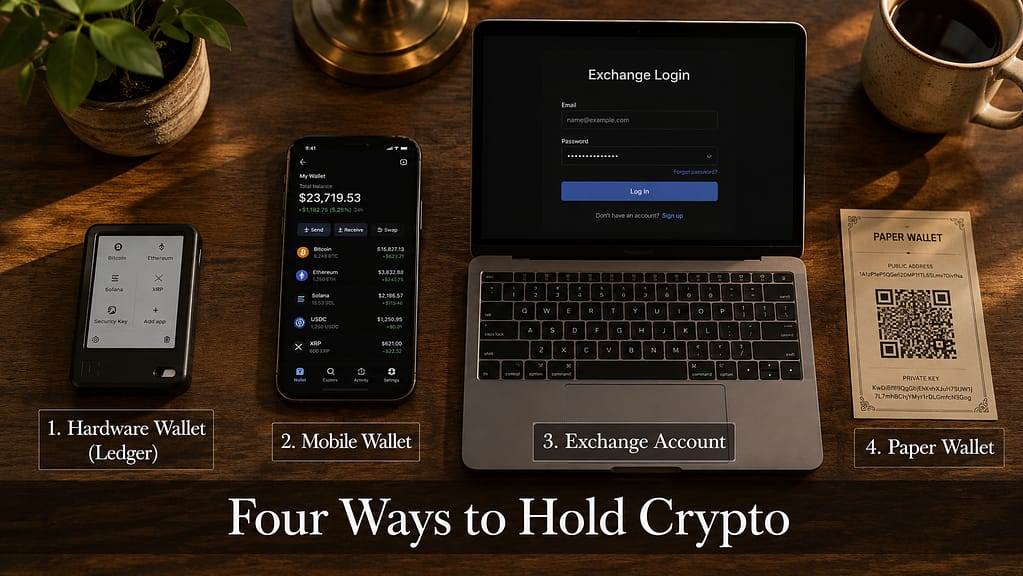
Before you settle on a device, it helps to see the four ways people actually hold crypto, because they are not equally safe and they are nowhere near equally reachable by your family. The wallet you choose decides two things at once: how hard it is for a stranger to steal your coins, and how hard it is for the people you love to inherit them.
A hardware wallet like a Ledger keeps your keys on a device that never touches the internet. It is the strongest option for anyone holding for the long term, and the only one that pairs top-tier security with a clean inheritance path, as long as you write down and safely store the recovery phrase. A mobile or software hot wallet lives as an app on your phone or computer. It is convenient for small, everyday amounts, but it is always connected, which means malware and a lost or wiped phone are real threats, and your family still needs both the app and the seed phrase to recover anything.
An exchange or custodial account, the Coinbase or Binance model, is the easiest to start with and the most dangerous to leave a legacy on. The company holds your keys, which means it can freeze the account, and after a death it often does, locking your family behind a verification wall they cannot clear. Coinbase in particular gives you no way to name a beneficiary on the account, so our guide to what happens to a Coinbase account when the holder dies covers the documents an executor has to produce instead. A paper wallet, keys printed and stored offline, is safe from hackers but fragile in every other way: fire, water, fading ink, or a family member who has no idea what the printout is or how to use it without exposing the keys.
Line them up and the pattern is clear. For crypto you intend to hold and one day pass on, a hardware wallet is the only choice that is both hard to steal and straightforward to inherit. Here is how the four compare.
| Wallet Type | Security | Can Your Family Inherit It? | Best For |
|---|---|---|---|
| Hardware wallet (Ledger) | Highest. Keys stay offline, in your control. | Yes, with a documented recovery phrase and a plan. | Long-term holdings you intend to pass on. |
| Mobile or software hot wallet | Moderate. Always online; exposed to malware and device loss. | Only if family has the app and the seed phrase. | Small, everyday spending amounts. |
| Exchange or custodial account | Low for legacy. The company holds the keys and can freeze it. | Hard. Accounts often lock families out after a death. | Active trading, not long-term storage. |
| Paper wallet | Strong against hackers, weak against real life. | Rarely. Fragile and confusing for heirs to use safely. | Tech-savvy holders with a solid backup plan. |
A Hardware Wallet Versus Leaving It on an Exchange
I learned the difference between owning crypto and being allowed to reach it the hard way. I spent months locked out of a custodial exchange account over an identity dispute I did not create and could not seem to resolve, watching funds I owned sit behind a login that treated me like a stranger. I was alive, I held every password, and I still could not get to my own money.
Now picture that same wall, except the person on the outside of it is your spouse, and you are not there to answer the verification emails. A custodial exchange can freeze an account the moment it senses something unusual, and a loss in the family is about as unusual as it gets. The account does not care that the person asking is your widow. It asks for proof she cannot give.
A hardware wallet takes that gatekeeper out of the equation. Nobody can freeze it, because nobody else holds the keys. That control is the entire point, and it is why I keep my own crypto on a device in my safe, with written instructions beside it, rather than trusting a company to hand it over on the hardest day of my family’s life. Self-custody is not about paranoia. It is about making sure the decision stays with the people you chose, not a support queue.

Ledger Versus Trezor for Long-Term Storage
Ledger and Trezor are the two names that come up in almost every hardware wallet conversation, and they take genuinely different approaches to security, recovery, and everyday use. Rather than repeat the full breakdown here, we put them side by side in our Ledger vs Trezor comparison, with a close look at what happens when a spouse, executor, or beneficiary eventually needs access.
The short version for the purpose of this review: both are far safer than leaving coins on an exchange, and both live or die on whether someone can find and use the recovery phrase later. Neither device solves the inheritance problem on its own. That part is on you, and it is the part almost no one plans for.
What a Ledger Does Not Solve
Here is the honest limitation, and it is the most important paragraph on this page. A Ledger protects your keys. It does not store the instructions your family needs to use them. The device in the drawer and the 24-word phrase on a slip of paper are worthless to your loved ones if no one knows they exist, what they are for, or where to look.
Who is legally allowed to reach your digital assets after you are gone is governed in most states by the Revised Uniform Fiduciary Access to Digital Assets Act, but the law only helps if your executor can actually locate the phrase. That means the recovery phrase needs a documented, secure home, and your executor needs to know it is coming. Our guide to where to store a seed phrase for inheritance walks through the storage options and the instruction layer that sits above them.
This is where the wallet stops and the plan starts. A hardware wallet handles the keys; a document vault handles the instructions, the passwords, and the recovery details, released to the right person at the right time. The two stack together, never either or. If you want the full picture of how crypto fits into an estate, start with our guide to crypto estate planning and the duties involved in our breakdown of a digital executor’s responsibilities. To see exactly which documents your situation calls for, the free Estate Readiness Tool walks you through it in a couple of minutes. There is also a third route that folds both halves together, a bitcoin inheritance vault where a second key holder can sign with you, so the keys and the instructions stop living in two separate places.
Give Your Family the Instructions, Not Just the Keys
One attorney-drafted estate document often runs several hundred dollars, more than a Ledger costs, and the wallet is the piece every one of those documents ends up pointing to. For a one-time purchase you take your keys off the exchanges that can freeze them and put them in your own hands, and setup is four guided steps, not a computer-science exam. Of the two halves of the plan, the vault and the device, this is the half entirely in your control today.
Who a Ledger Is For, and Who Should Look Elsewhere
A Ledger is the right tool if you hold a meaningful amount of crypto for the long term, you want it off exchanges and under your own control, and you want your family to inherit it cleanly instead of hunting for it. If that is you, this is one of the most important purchases you will make for your holdings.
It is honestly more than some people need right now. If you hold a small amount you actively trade every week on an exchange, a hardware wallet adds friction that may outweigh the benefit until your position grows. And if you know in your heart you would lose a slip of paper with 24 words on it, the device is not your first step. Your first step is a documented storage plan for the phrase, because a recovery phrase you cannot find is the same as no wallet at all. Sort out where the instructions will live, using the Estate Readiness Tool, then buy the device.

Getting Started With Your Ledger
Setting one up is straightforward, and doing it in the right order is what protects your family later.
- Buy only from the official Ledger source.
Never a third-party reseller or a marketplace listing, because a tampered device is the one real way these get compromised.
- Set your PIN and let the device generate your 24-word recovery phrase.
Write it by hand. Never photograph it, type it, or store it in the cloud.
- Give the recovery phrase a documented, secure home, and record where the device itself is kept.
This is the step that turns a wallet into a plan.
- Tell your executor or a trusted family member that the crypto exists and that instructions are waiting for them.
They do not need the phrase today. They need to know it is coming and where to look.
Do those four things and you have done what almost no crypto holder does: you have made your assets both secure from strangers and reachable by the people you actually want to have them.
Don’t Leave Your Crypto Where No One Can Reach It
The crypto that goes unclaimed is almost never stolen. It is simply left behind, on a blockchain nobody in the family knew how to open. A Ledger is a one-time purchase, no subscription, that protects a holding you may spend years building, and it turns owning crypto into something your family can actually inherit. You have read the honest version, the strengths and the one real gap, and this is the step that closes both.
Set It Up From Your Phone, or Hand It to the Family Member Helping You
You do not need to be at a desk to get this handled. Scan the code below and Ledger’s official store opens on your phone, ready to set up in about fifteen minutes. It is also the easiest way to pass the task to an adult child or the person helping you organize your affairs: they scan, they order, and the plan moves forward.
 Get My Ledger
Take the Answers With You, or Hand Them to Your Family
This whole FAQ fits on one page you can print. Keep it tucked in with your recovery phrase, or give it to the adult child or executor who will one day need to act on it, so the answers are in their hands before the questions ever come up.
Ledger and Crypto Inheritance: Frequently Asked Questions
Straight answers to what crypto holders and their families ask most about hardware wallets, recovery, and access.

|
As Featured In
CBS · ABC · Fox · AP · Business Life Magazine · The New York Telegraph · Insider Weekly · Tampa Bay Observer · Benzinga · SociologyGroup.com · Animal Hospice Group · MemoriaSky.com
Member in the Spotlight, Home Funeral Alliance · Cake.com Professional Directory · Cited by Google AI Overviews
|