
Home › Legacy Planning › Legacy & Estate Planning Services › Legacy Tools & Resources › Bitcoin Inheritance Plan
What Happens to Your Bitcoin When You Cannot Reach It Yourself
An adviser told me about a retired couple who kept their hardware wallet in the glove box of their car. He was not worried about a thief. He was worried about an intersection, a wet road, and an ambulance, because the device in that glove box was the only thing standing between their savings and nothing at all.
That is the part almost nobody plans for. We are careful about the wallet, the backup, the fireproof bag, the hiding place. We think about the device being stolen. We do not think about the morning when the person who knows where it is cannot tell anyone, cannot remember, or cannot be woken up.
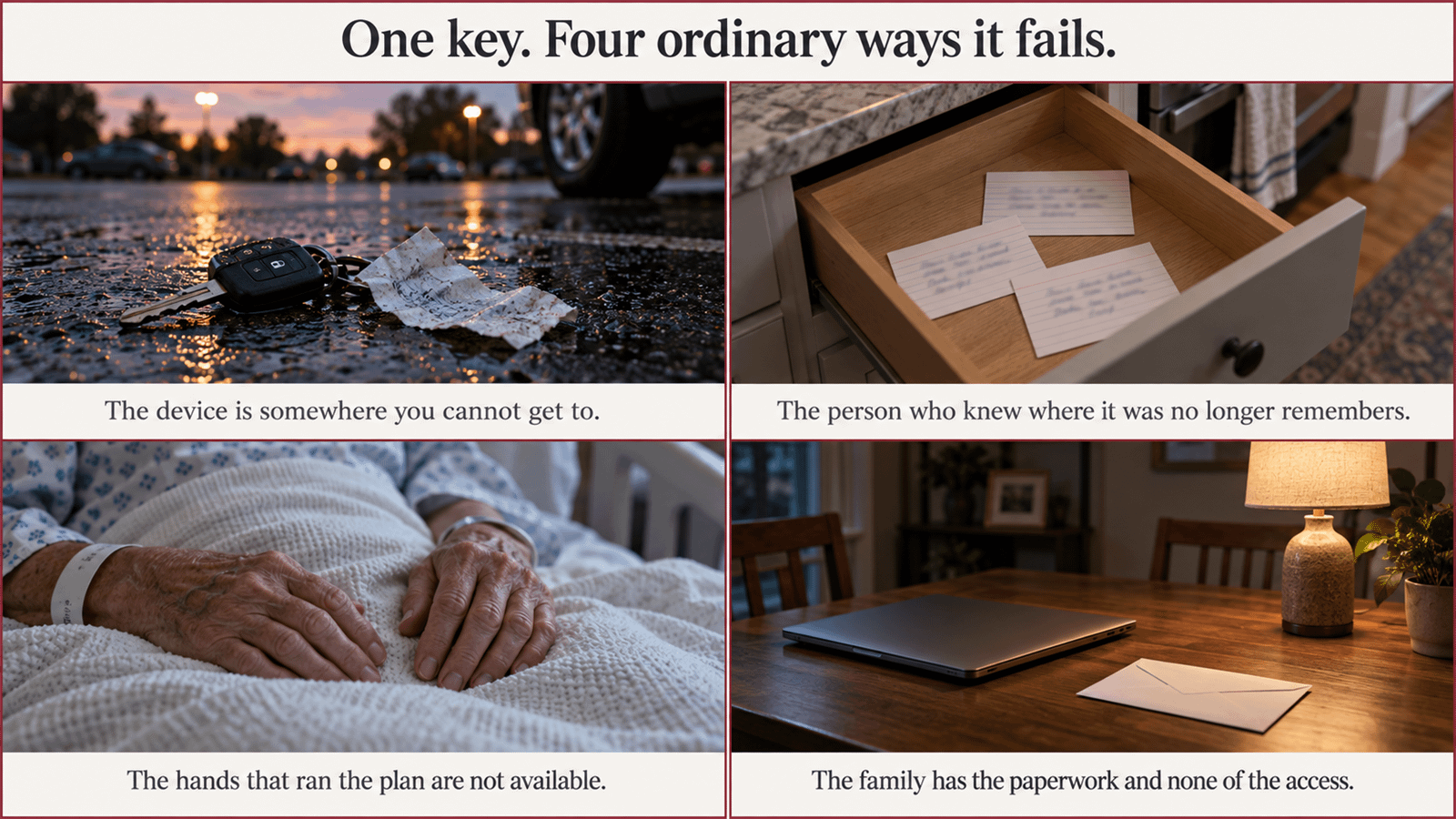
A self custody wallet protects you under three conditions, all at once. You have to hold the keys. You have to know where they are. You have to be able to use them. Every one of those three is a condition about you, not about the technology, and life takes them away in the ordinary ways it always has. A car accident takes the first. Dementia takes the second. A stroke takes the third. The Bitcoin does not go anywhere. It sits on the network, perfectly safe, perfectly untouchable, while the people you were saving it for stand in a room holding a device nobody can open.
I set up a plan for my own Bitcoin because of that gap, and I am going to walk you through exactly what I found, what it cost, what it protects, and where it falls short. This is not theory for me. I am a client.
The Bitcoin Adviser builds you a 2 of 3 Bitcoin vault: you hold one key, they hold one, an independent vault company holds the third, and any two of the three can approve a transaction. It costs 1 percent of your Bitcoin a year with nothing paid upfront, and it comes with a written recovery plan your family can follow without you.
- Your signing key lives either on an iPhone or on a hardware device, because The Bitcoin Adviser does not use Android for the client key.
- Deposits and withdrawals cost nothing, and every deposit appears as its own line in the vault rather than being pooled.
- Your heirs need three things to begin recovery: a death certificate, a will or a court-appointed authority, and identification for the executor.
- The annual fee steps down to 0.75 percent in years five through eight, then 0.50 percent from year nine onward.
Ending the agreement inside the first four years costs 4, 3, 2 or 1 percent of your balance depending on the year, and every withdrawal begins with a confirmation call with your adviser. Both are protections and both are friction, and you should know about them before you sign rather than after. This is Bitcoin only, so a portfolio of other coins is not served here, and anyone who wants no third party at any layer should be building their own multisig instead.
You are not handing anyone your Bitcoin. You are removing the one place where everything fails at once.
The first question I asked was why I would give a company a key at all. What satisfied me is that The Bitcoin Adviser cannot start a transaction, cannot move Bitcoin alone, and cannot shut you out: you begin every spend yourself, and if they disappeared tomorrow you could sign with the vault company instead and take the whole setup elsewhere. What the fee actually buys is a named adviser who answers the phone, sits on the call while your vault is built, and writes the recovery document your family will be handed. Building this yourself is possible and costs nothing, and it also means the people you leave behind inherit a system only you ever understood.
1 A fit call, no pitch.
2 Verify your ID, sign.
3 Build the vault live.
4 Send a first deposit.

The Three Things a Self Custody Wallet Assumes About You
Hold the keys. Know where they are. Be able to use them. Say those out loud with a specific person in mind, someone in your family who is seventy, and you can already feel where the plan breaks.
The first condition fails through ordinary accidents. A house fire. A move where a box goes to the wrong place. A device in a glove box and a collision on the way home from the grocery store. Bitcoin held on a single signing device has a single point of failure, and a single point of failure is not a security model, it is a bet that nothing unusual will ever happen to you.
The second condition fails through memory. The Alzheimer’s Association reports that an estimated 7.4 million Americans age 65 and older are living with Alzheimer’s in 2026. A person in the early stage of it can still talk, still drive, still pay for groceries, and still be unable to tell you which of three drawers holds the recovery words, or whether the words in the drawer are the current ones. Nothing about that reads as an emergency until the day it matters.
The third condition fails through the body. A stroke, a cardiac event, a fall, a coma. The keys are exactly where they always were, the person knows exactly where they are, and neither fact helps, because the hands and the voice that were supposed to operate the plan are not available.
Now add the one nobody wants to name. Violent crime has followed the money. Chainalysis tracked roughly $58 million stolen in violent attacks on crypto holders in 2025, with more than $30 million already taken by the middle of 2026, and home invasions accounting for 37 percent of the incidents they recorded this year. A plan where one person can move everything is a plan where one frightened person, alone, can be made to move everything.
Can Bitcoin Be Inherited?
Yes, and the mechanism is simpler than the vocabulary makes it sound. Bitcoin is not held by a company on your behalf the way a brokerage account is. It moves when someone signs for it with a key. So inheritance is not a question of who is named on a document. It is a question of who can sign, and whether they know how.
That is why so many otherwise careful plans fail. A will assigns legal authority. Probate is the court process that proves the will and supervises the estate, and it works well for a house, a bank account, and a car, because a court order can compel a bank to release funds. No court order compels the Bitcoin network to do anything. If your family holds legal authority and nobody holds the key, they have a piece of paper and a locked door.
The exchange route has its own version of the same problem. Coinbase does have a process for a deceased account holder, and we walk through it in detail in our guide to naming a Coinbase beneficiary. It works, on their terms, on their timeline, for the Bitcoin you leave with them. It does nothing for the Bitcoin sitting on a device in your closet, which for most long term holders is where the serious money lives.
What a Bitcoin Inheritance Plan Actually Looks Like
A real plan does two things that a wallet alone cannot. It removes the single point of failure, so no lost device, lost memory, or lost person strands the Bitcoin. And it hands the people who come after you a written path they can follow while they are grieving, which is the worst possible time to learn a new technology.
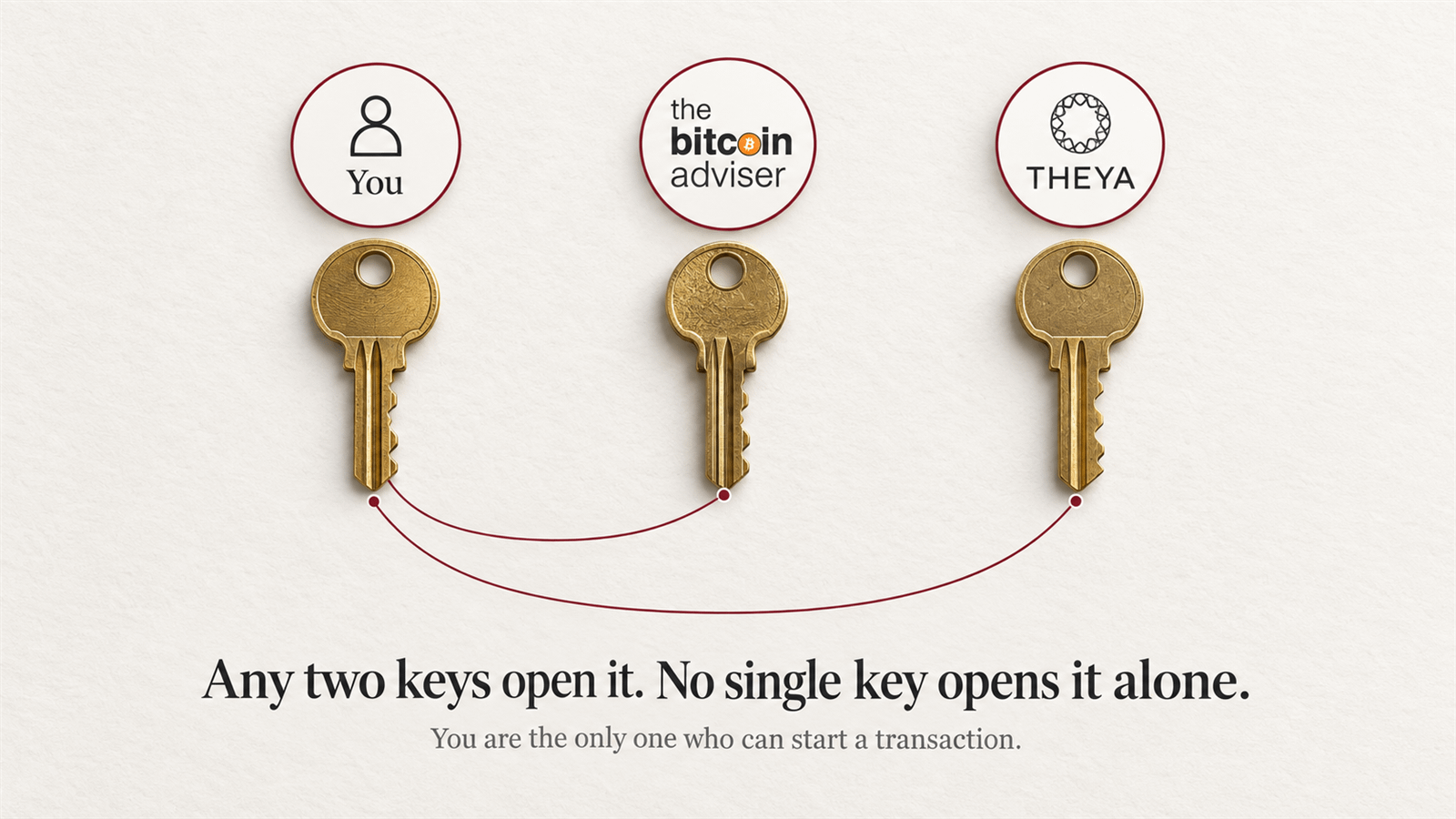
Three keys, any two open it
The structure I use is a 2 of 3 vault. Picture three house keys to the same door. You hold one. The Bitcoin Adviser holds one. An independent vault company holds the third. The door opens when any two of those keys turn, which means no single key, and no single person, can move your Bitcoin alone. Not you by yourself. Not them. Not anyone who takes one key from one location.
Read that again with the failures from the last section in mind, because it answers all four. Lose your device and two keys still exist. Lose your memory and the adviser you worked with is still there with the documentation. Lose consciousness and the structure your family was shown still functions. Face a person demanding you move everything right now, and you genuinely cannot do it alone, which is a strange kind of protection to be grateful for.
Who can start a transaction, and who cannot
This is the question I brought to my first call, and it is the one that decides whether a plan like this is worth anything. You are the only one who can start a transaction. The Bitcoin Adviser states plainly on their own site that they cannot initiate a transaction and cannot move the Bitcoin alone, and neither can the vault company. Their role is the second signature on a spend you began, after they confirm you are you and that nobody is standing behind you.
They also cannot lock you out, and they say so in writing: if they disappeared tomorrow, you could still start a transaction and get a second approval from the vault company, and you could migrate the whole setup somewhere else without them. That is the difference between a service you are using and a service you are trapped in, and it is worth confirming before you hand anyone a key to anything.
What your family receives in writing
The structure is half of it. The other half is the document, and this is the piece I did not expect to value as much as I do. You build an Estate Plan Protocol with your adviser: who to contact, what to verify, what the steps are, in plain language rather than technical riddles. It supplements your will, it does not replace it, and it is meant to live where your family already keeps the important papers, not in a probate filing.
That document is the one that gets used at the exact moment nobody is thinking clearly. I have watched a family try to settle an estate with the pieces scattered across a filing cabinet and a phone nobody could get into, and the difference between a family with a map and a family without one is not the money. It is the weeks.

The Bitcoin Adviser Review: What I Found After Setting Up My Own Vault
I did not write this page and then sign up. I signed up, ran the whole process, and then wrote it, and here is the honest account of it.
What the first call covered
Thirty to forty five minutes, and it was not a sales call. We talked about my situation and whether the structure fit it, and then the conversation went well past Bitcoin. We covered which exchanges keep trading and network fees low, which sites are worth using, and general investing, and he walked me through things I believed I already understood in a level of detail I did not have before. He gave me an open calendar and told me to reach out any time.
The closest word for it is fiduciary, and I want to be careful with that word because The Bitcoin Adviser is explicit in their own terms that they provide education and operational support for self custody, not financial, tax, or legal advice. What I am describing is access and plain English teaching from a person who answers the phone. For a family whose real fear is being alone with something they do not understand, that access is the product.
What setup took, start to finish
Identity verification through DocuSign, about five minutes, done before the agreement is signed. It exists so that when a withdrawal is requested later, they can verify it is really you, and so a legal estate recovery is possible for your executors. They state that they do not keep copies of the ID documents in their own systems.
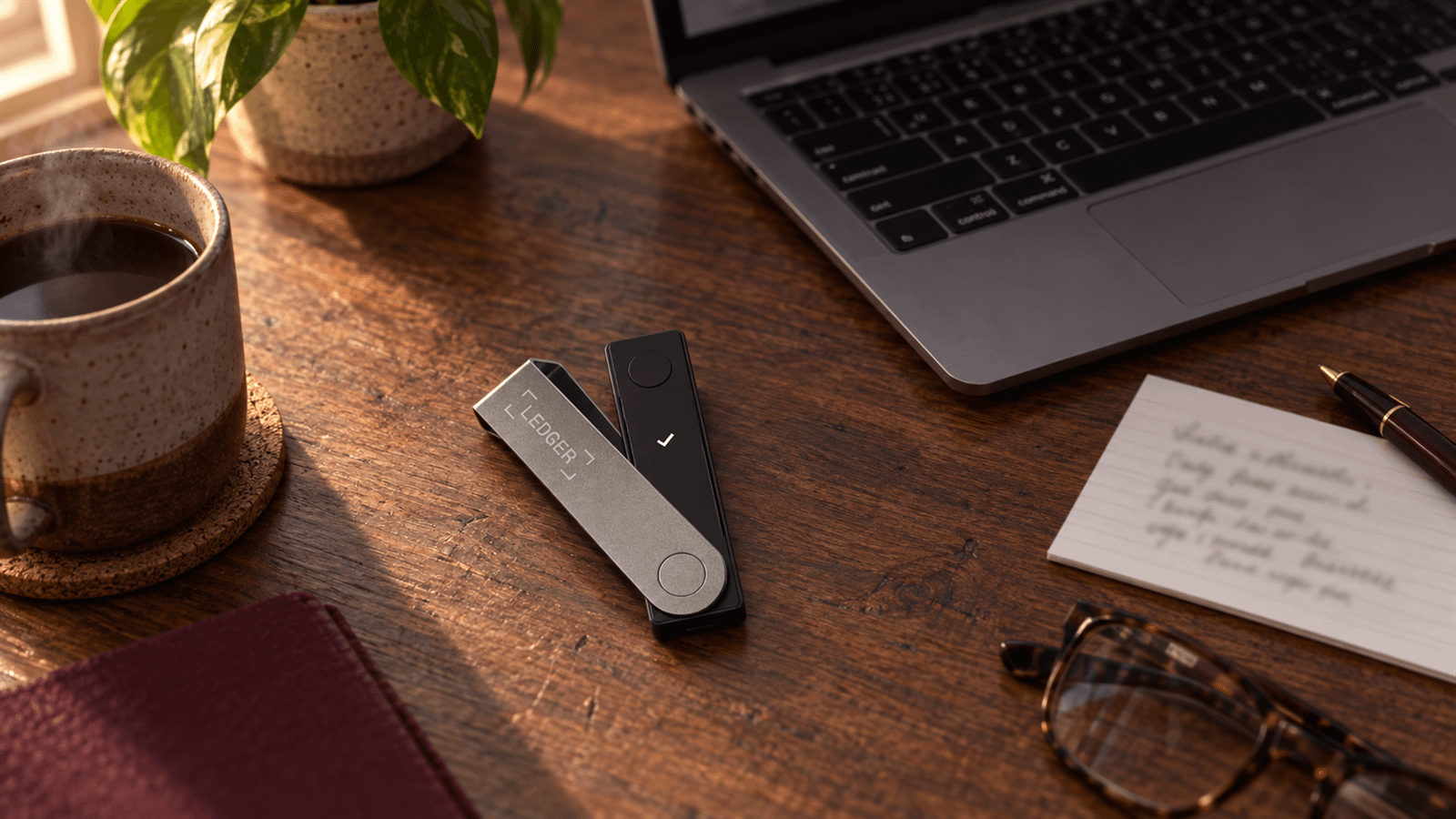
Then a live session to create the vault, in the Theya app, around fifteen minutes with the adviser on the call the whole time. I used a Ledger Nano X I already owned. They typically set clients up with a Trezor and will help you order the right model, and both the Trezor Safe 5 and the Ledger are covered in our own reviews if you are choosing your first one.
Then the first transfer, guided, at whatever pace you want. I started with one hundred dollars to watch the whole thing work end to end before moving anything that mattered. You can start smaller. Nothing about the account requires a minimum to open, and there is no setup fee, which is worth knowing before you talk yourself out of testing it.
The app itself surprised me. The vault reads like a simple ledger, every deposit on its own line, nothing buried in menus. It is the cleanest interface of this kind I have used, and for a page like this that matters, because the person I want to hand this to is not going to forgive a confusing screen.
What it costs, including the fee for leaving early
One percent a year in years one through four, dropping to 0.75 percent in years five through eight, then 0.50 percent from year nine. It is calculated on the average Bitcoin balance in the vault, billed every ninety days after the fact, and paid in Bitcoin. Nothing is charged until the accrued fee reaches one hundred thousand sats.
Deposits are free. Withdrawals are free. Adding another hundred dollars next month is free, and it shows up as its own line rather than being pooled into the first one. The fee is the annual percentage and that is all, with one exception you deserve to know about before you sign rather than after.
If you end the agreement inside the first four years, there is an early termination fee, charged on the Bitcoin balance at the time you leave: four percent in year one, three percent in year two, two percent in year three, one percent in year four, and nothing from year five onward. Their own terms describe it as protection for the heavy implementation work in the early years and state that it is not intended to operate as a routine charge.
Put it in proportion. Nothing in normal use triggers it. You would have to decide to end the service entirely, and a client who simply wanted to stop paying the annual fee could keep a small balance under advisory instead of terminating. Weigh it against what moving Bitcoin around usually costs: exchange fees on every trip, network fees, and a taxable event every time you sell to move. Four percent once, in the unlikely event you walk away in the first year, is not the same species of cost as a toll you pay every time you touch your own money.
Who this is not for
If your holdings are small enough that a percentage fee feels heavier than the risk it removes, wait. If you want no third party involved in any form, this is not your structure and you should be looking at your own multisig setup instead. If you hold a portfolio of other coins, this is Bitcoin only, and that is deliberate. And if the idea of a phone call before a large withdrawal bothers you, know that it is a standing requirement, not an occasional one.
iPhone or Hardware Wallet: Which One Your Plan Needs
Your key can live in one of two places, and which one depends on the phone in your pocket.
If you carry an iPhone, the key can live on the phone itself, protected by the phone’s security chip and restorable to a replacement phone. The Bitcoin Adviser’s own guidance states plainly that they do not use Android for this role, so if you carry an Android phone, your key lives on a hardware signing device instead. An iPhone owner who would rather hold a physical device can still choose one, and they accept a device you already own if it meets their standards and works with the vault software.
For a new purchase they recommend Trezor, and they will point you to the right model. If you want to understand the differences before you buy, our Ledger and Trezor comparison lays them out side by side, and the legacy tools directory carries the rest of what we have vetted in this space.
 Used by Memorial Merits
The device on my own desk, and the one in the setup photos on this page.
Get the Nano X
Used by Memorial Merits
The device on my own desk, and the one in the setup photos on this page.
Get the Nano X
 Recommended by The Bitcoin Adviser
What they point you to when you are buying a device for the first time.
See It at Trezor
Recommended by The Bitcoin Adviser
What they point you to when you are buying a device for the first time.
See It at Trezor
Why Your Recovery Words Never Belong in a Will
This is the single most common mistake in crypto estate planning, and it is the one with no undo button.
A will is a document that gets filed with and proved by a court. Court files are not private the way a safe deposit box is private. Recovery words written into a will are recovery words handed to a filing system that was never designed to keep a bearer asset secret, and anyone who reads them can take the Bitcoin, immediately and irreversibly, with no bank to call and no transaction to reverse.
The rule is to keep the two layers apart on purpose. Legal authority goes in the will: who inherits, who serves as executor, what your intent is. Operational access goes in a private document that never enters a public filing, which is exactly what an Estate Plan Protocol is for. We go deeper into the mechanics of that split in our guide to seed phrase estate planning, and into the broader legal picture in crypto estate planning.
What Your Family Needs the Day After You Pass
Three things, and none of them are technical.
A death certificate. A will, or, if there is no will, whatever your state decides about who has authority. And identification for the executor or authorised representative. That is the doorway. The Bitcoin Adviser verifies the executor, then works through the documented transition, and their terms state that processing happens within sixty business days once the documentation is in hand.
Here is the part that answered my own worst fear. The account cannot be locked away from your family, and the company never holds the Bitcoin. They are not a custodian. They do not take possession of your coins, your recovery words, or your device. They facilitate a safe entry and a safe exit, and if they vanished, the structure still works without them.
If you are the person reading this after a death rather than before one, start with our walkthrough for a digital executor, and take your time. Nothing about crypto recovery rewards speed, and a great deal of it punishes a rushed decision.
How This Compares to Casa, Unchained, and Leaving It on an Exchange
Leaving it on an exchange is the default, and it is the one with the clearest failure mode: the platform controls the keys, the platform sets the rules for what happens when you pass, and the platform can change those rules. The Bitcoin you can see in an app is not the same thing as the Bitcoin you control.
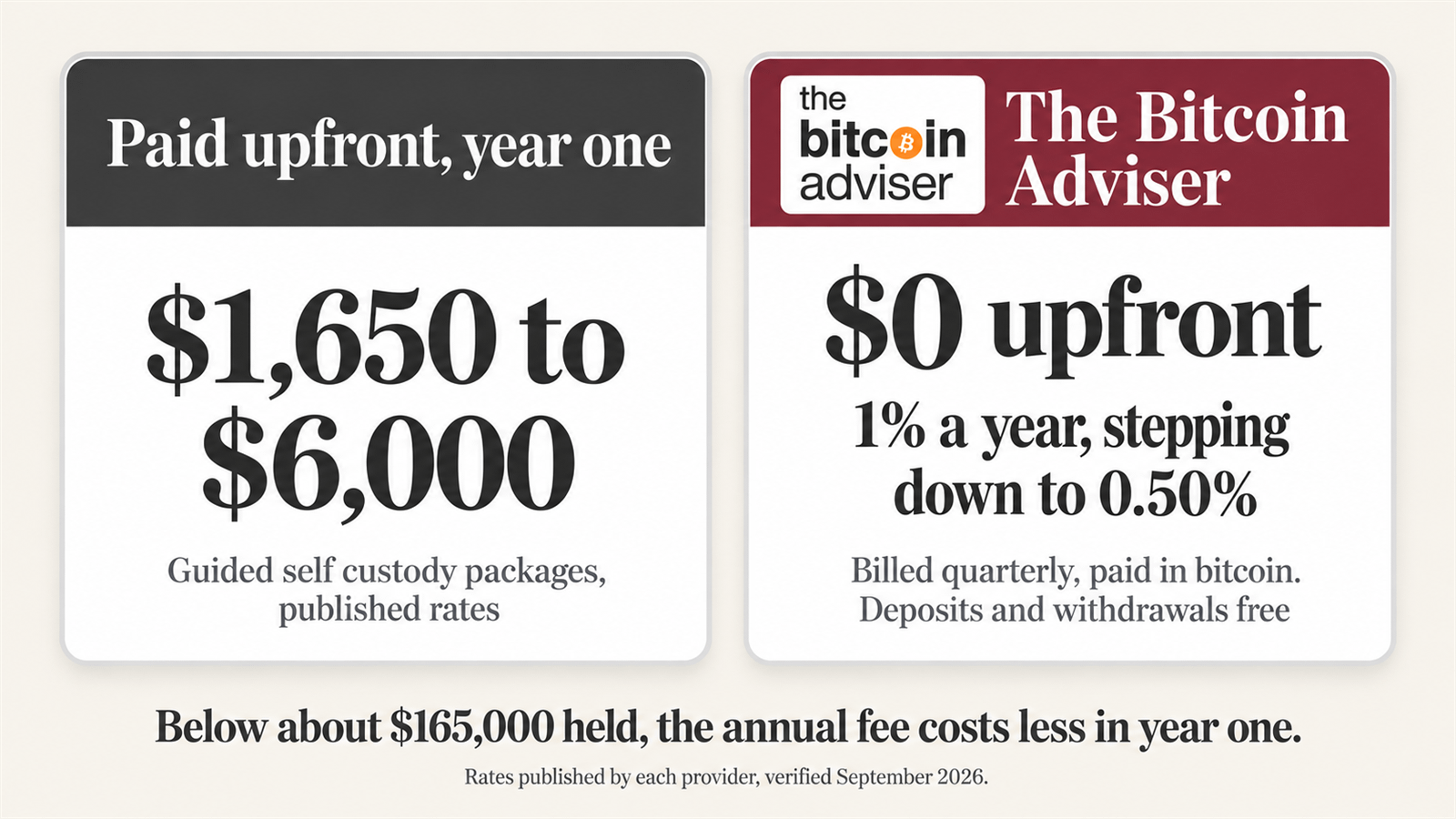
Unchained and Casa are the two names you will meet if you research collaborative custody, and they are real companies doing real work. The difference that matters for a family rather than an institution is how they charge. Unchained’s guided self custody packages start at $1,650 and run to $2,650 upfront, with their Signature tier at $6,000 in the first year, renewing at $4,500, all published on their own pricing page. The Bitcoin Adviser charges nothing upfront and takes one percent a year.
Run the arithmetic on your own number and the answer falls out. Below roughly $165,000 in holdings, one percent a year costs less in year one than the cheapest upfront package elsewhere. Above that, the flat fee starts to win, and the honest answer is that a larger holder should price both. That is not a knock on anyone. It is the reason I can recommend this particular structure for the family I am writing to, which is the family with a meaningful amount of Bitcoin and no institution behind them.
| How it is held | Who can move it | If the owner cannot act |
|---|---|---|
| Left on an exchange | The exchange controls the keys and sets the rules | The family follows that exchange’s process, on its timeline |
| One hardware wallet | Whoever holds the device and the recovery words | Nothing moves, and nothing can compel it to move |
| Your own multisig | Whoever holds the required number of keys | It depends entirely on how well the setup was documented |
| Collaborative 2 of 3 vault | The owner starts it, and two of three keys approve it | The written plan names who to contact and what to verify |
Refer Someone and Earn Bitcoin on It
One thing here is unusual enough to name, and I want to be direct about my own position in it.
The Bitcoin Adviser runs an open referral program. Anyone can introduce someone, including a client introducing a sibling or a friend, and the referrer earns ten percent of that person’s fees, paid quarterly in Bitcoin, for as long as they stay a client. Their own published example is a client holding 3 BTC generating 0.003 BTC a year to whoever made the introduction.
| If you introduce | Their combined holdings | You earn each year |
|---|---|---|
| One friend | 1 BTC | 0.001 BTC, for as long as they stay a client |
| Three family members | 5 BTC | 0.005 BTC, for as long as they stay clients |
| A small circle | 20 BTC | 0.02 BTC, for as long as they stay clients |
Memorial Merits earns that same ten percent on anyone who signs up through this page. That is how this site pays for itself, and you should weigh every recommendation here with that in front of you rather than buried under it. It is also why the fee schedule, the early termination fee and the parts that do not fit everyone are all on this page instead of on a page you would have to go find.
The Risk Nobody Puts in the Brochure
The reason I am comfortable recommending a structured plan at all is that the alternative is not neutral, and the numbers on the alternative are ugly.
The FBI’s Internet Crime Complaint Center recorded $9.3 billion in cryptocurrency fraud losses across 149,686 complaints in 2024, a 66 percent jump in losses, with people over 60 reporting the largest share at roughly $2.8 billion. The Federal Trade Commission reported that consumers lost more than $12.5 billion to fraud in 2024, up 25 percent, and that more money was lost to scams paid by cryptocurrency than all other payment methods combined. On Bitcoin ATMs specifically, the FTC found that people 60 and over were more than three times as likely as younger adults to report a loss, with a median reported loss of $10,000.
Read those three numbers together and a pattern shows up that has nothing to do with technology. The people being hurt worst are the people least likely to have someone to call before they act. A plan that includes a human being who verifies a transaction before it happens is not just an inheritance tool. It is a second pair of eyes on the day someone calls your father and tells him his account has been compromised.

|
As Featured In
CBS · ABC · Fox · AP · Business Life Magazine · The New York Telegraph · Insider Weekly · Tampa Bay Observer · Benzinga · SociologyGroup.com · Animal Hospice Group · MemoriaSky.com
Member in the Spotlight, Home Funeral Alliance · Cake.com Professional Directory · Cited by Google AI Overviews
|